







Why Mold in Your Air Ducts Is a Bigger Problem Than You Think
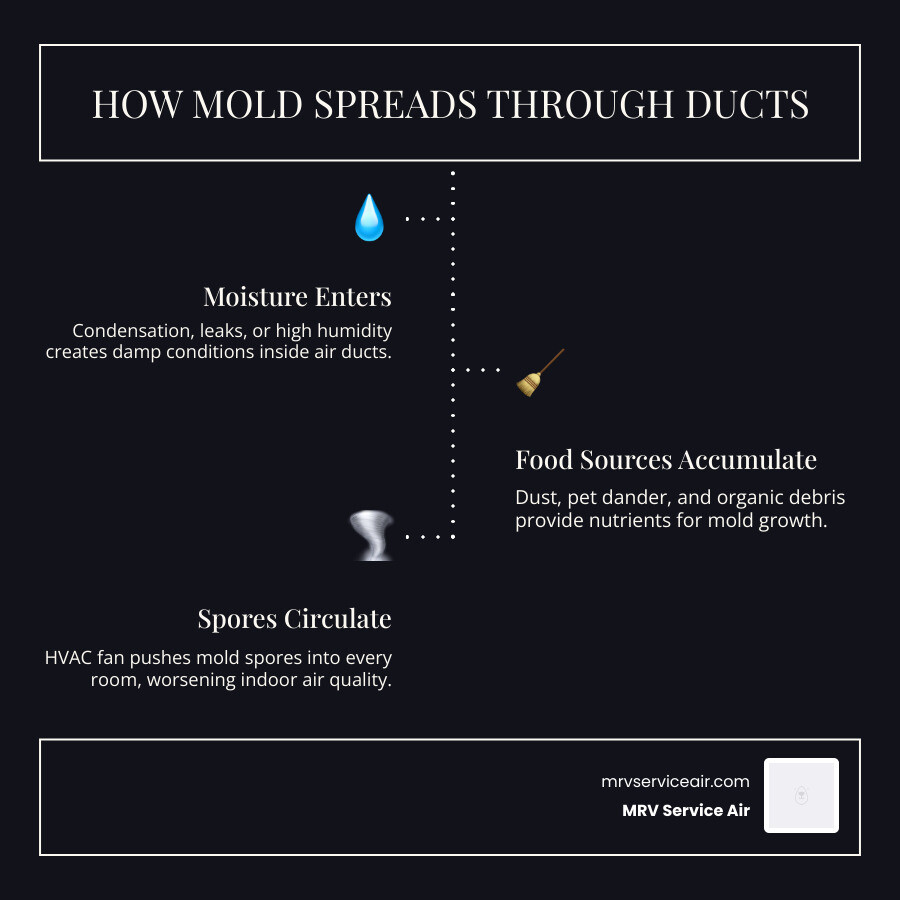
How clean ducts reduce mold risk in your home comes down to a simple idea: mold needs three things to grow — moisture, warmth, and something to feed on. Your air ducts can quietly provide all three, especially here in the Central Valley where heat and humidity create the perfect conditions for fungal growth inside your HVAC system.
Here is a quick summary of how clean ducts help:
- Remove food sources – Dust, pet dander, and organic debris inside dirty ducts give mold exactly what it needs to grow and spread
- Reduce moisture buildup – Clean, well-maintained ducts allow for better airflow and drainage, limiting the damp conditions mold thrives in
- Stop spore circulation – Once mold takes hold inside ductwork, your HVAC system can push spores into every room every time it runs
- Enable early detection – Professional cleaning includes an inspection that catches leaks, condensation issues, and early mold growth before it spreads
- Lower recurrence risk – Removing the organic material mold feeds on makes it significantly harder for mold to return after remediation
Most homeowners focus on surface mold in bathrooms or basements. But your air ducts are one of the easiest places for mold to quietly become a whole-house problem. Every time your system kicks on, air passes over contaminated surfaces and carries mold spores into your living spaces — often without any visible warning sign until the problem is already serious.
The EPA notes that if insulated ductwork gets wet or moldy, it cannot be effectively cleaned and must be replaced entirely. That makes routine attention to your ducts far less costly than waiting until the damage is done.
Understanding How Clean Ducts Reduce Mold Risk in Your Home
When we talk about mold in the HVAC system, we aren’t just talking about a little bit of dust. Mold is a living fungus that requires a specific environment to flourish. Air ducts are often dark, out of sight, and can become damp due to condensation or high humidity. In April 2026, as we move into the warmer months in Delano, the temperature difference between the hot attic air and the cool air inside your ducts can cause “sweating” or condensation.
How clean ducts reduce mold risk in your home is primarily by breaking the cycle of growth. Mold spores are everywhere—they enter through open doors, windows, and even on your clothes. However, they only become a problem when they find a place to land and grow. By keeping your ductwork clean, you remove the “soil” (dust and debris) that allows these spores to take root. Without that organic material, even if a spore enters the system, it has nothing to feed on.
Furthermore, when humidity levels exceed 50%, the risk of mold growth skyrockets. Clean ducts facilitate better airflow, which helps regulate humidity and prevents the stagnant, damp air that mold loves. If you are concerned about the air circulating through your home, you can find more info about indoor air quality services to help keep your environment safe.
Identifying the Warning Signs of HVAC Contamination in Delano
In our experience serving the Delano area, mold in air ducts is often a “hidden threat.” Because your ductwork is tucked away behind walls and in ceilings, you might not see the mold itself until the infestation is significant. However, your senses will often pick up on the problem before your eyes do.
The most common sign is a persistent musty or “earthy” odor that only appears when the AC or heat is running. This is sometimes called “Dirty Sock Syndrome,” though that can also be caused by bacteria on the coils. If the smell fades when the system is off, the source is likely inside your ventilation.
Other physical signs include:
- Visible Growth: Dark, fuzzy, or slimy patches around the edges of your supply registers.
- Health Symptoms: Family members experiencing unexplained sneezing, runny noses, or itchy eyes that seem to worsen when they are indoors.
- Condensation: Seeing standing water or heavy moisture around your vents or air handler.
If you notice these signs, it is important to act quickly. Ignoring a musty smell can lead to the mold spreading through the entire system. For homes with complex layouts, getting more info about ventilation work can ensure your system is breathing correctly.
How Clean Ducts Reduce Mold Risk in Your Home by Removing Food Sources
It might surprise you to learn what actually accumulates inside your vents. It’s not just “dust.” Over time, your ducts become a collection point for:
- Dead skin cells (a primary component of household dust)
- Pet dander and hair
- Pollen and plant particles
- Spider webs and insect remains
- Fiberglass particles from deteriorating insulation
Mold views this buildup as an all-you-can-eat buffet. By scheduling a professional cleaning, we mechanically remove this organic debris. This is a critical step because even if you kill the mold with a sanitizer, leaving the dead mold and dust behind provides the perfect foundation for the next colony to move in. Understanding the state of your system is easier when you have more info about duct work services and how they address these contaminants.
The Professional Approach to Mold Remediation in the Central Valley
Cleaning mold out of a duct system is not a DIY job. In fact, if you try to vacuum out mold with a standard household vacuum, you might actually make the problem worse by exhausting millions of spores back into your living room air.
At MRV Service Air, we follow a rigorous process to ensure the mold is gone and stays gone:
- Containment: We use negative air pressure to ensure that any dust or spores dislodged during the cleaning are pulled directly into our vacuum system and not into your home.
- HEPA Filtration: Our equipment uses High-Efficiency Particulate Air (HEPA) filters, which are capable of trapping particles as small as 0.3 microns (including mold spores).
- Mechanical Agitation: We use specialized brushes and air whips to scrub the interior surfaces of the ducts, dislodging the “biofilm” that mold creates.
- Sanitization: Once the surfaces are clean, we can apply EPA-approved disinfectants designed specifically for HVAC use to kill any remaining microscopic spores.
This comprehensive approach is part of our commitment to providing central HVAC services that prioritize your family’s health.
How Clean Ducts Reduce Mold Risk in Your Home Through Expert Inspection
One of the biggest benefits of professional cleaning is the inspection that comes with it. We don’t just “suck out the dust”; we look for the reason the mold started in the first place.
During a visit, we check for:
- Air Leaks: Gaps in the ductwork that pull in humid air from the attic or crawlspace.
- Insulation Issues: Damaged or missing insulation that causes the metal to get cold and develop condensation.
- Drainage Problems: Clogged condensate pans or drain lines that allow water to back up into the system.
Without fixing these root causes, the mold will eventually return. Working with an experienced hvac contractor ensures that these mechanical issues are addressed alongside the cleaning.
Essential Moisture Control Strategies for Local Homeowners
The golden rule of mold prevention is: Control the moisture, control the mold. Even the cleanest ducts in the world will eventually grow mold if they are constantly wet. We recommend that Delano homeowners keep their indoor humidity levels below 50%.
| Duct Material | Mold Risk | Remediation Method |
|---|---|---|
| Sheet Metal (Non-porous) | Moderate; mold grows on surface dust. | Can be effectively cleaned and sanitized. |
| Fiberglass Duct Board (Porous) | High; mold can grow into the fibers. | Often requires replacement if heavily contaminated. |
| Flex Duct (Plastic Lined) | Moderate; can be cleaned but easily damaged. | Careful mechanical cleaning or replacement. |
To keep humidity in check, consider using dehumidifiers in damp areas and ensuring your bathroom and kitchen fans vent directly to the outside. If your HVAC system is oversized, it might “short-cycle,” meaning it doesn’t run long enough to properly dehumidify your home. This is where energy efficiency services can help by ensuring your system is sized and tuned correctly for our climate.
Long-Term Maintenance for a Healthier Indoor Environment
Preventing mold is an ongoing process, not a one-time event. To keep your air clean year-round, we suggest a proactive maintenance schedule:
- Change Filters Regularly: Use high-quality pleated filters and change them every 1-3 months. This prevents dust from entering the ducts in the first place.
- Annual Tune-Ups: Have a professional inspect your coils and drain pans once a year. A dirty cooling coil is a major source of moisture and mold.
- Monitor Humidity: Invest in a simple hygrometer to track your indoor humidity.
- Dust and Vacuum: Keeping a clean home reduces the amount of material that can be sucked into your return vents.
Whether you need a quick ac service to check your cooling efficiency or a check-up on your heating systems before winter, regular professional attention is the best defense against mold.
Frequently Asked Questions about Duct Cleaning and Mold
Does professional duct cleaning effectively remove mold?
Yes, professional cleaning that uses mechanical agitation and HEPA-filtered vacuuming can effectively remove visible mold and the debris it feeds on from hard-surface ducts. However, if the mold has deeply penetrated porous materials like fiberglass insulation, those sections usually need to be replaced.
How frequently should air ducts be cleaned to reduce mold risk?
For most homes in the Central Valley, we recommend a professional cleaning every 3 to 5 years. However, you should schedule a cleaning sooner if you have had a water leak, completed a major home renovation, or if anyone in the home suffers from severe allergies or asthma.
What are the limitations of duct cleaning for mold removal?
Duct cleaning is a removal process, not a permanent “cure.” If the underlying moisture issue—such as a roof leak, a plumbing leak, or high indoor humidity—is not fixed, mold will eventually return. Cleaning must be part of a larger strategy that includes moisture control.
Conclusion
At MRV Service Air, we know that your home is your sanctuary. How clean ducts reduce mold risk in your home is a vital part of maintaining that sanctuary’s safety and comfort. By removing the food sources mold needs and identifying moisture problems early, you can breathe easier knowing your air is clean and your HVAC system is running efficiently.
We are proud to serve the Delano community and the surrounding Central Valley with prompt, quality service at affordable prices. Don’t wait until a musty smell becomes a major health concern or an expensive repair. Schedule your professional inspection today and let us help you keep the “dirty truth” out of your air ducts.