







Why Indoor Air Quality in Agricultural Areas Deserves Your Full Attention
How to improve indoor air quality in agricultural areas is one of the most important questions rural homeowners and farm operators can ask. Here’s a quick overview of the most effective steps:
- Install high-efficiency air filters (MERV 11 or HEPA) in your HVAC system
- Use activated carbon filters to remove ammonia, VOCs, and odors
- Seal gaps and weatherstrip doors and windows to block outdoor contaminants
- Run ventilation systems with fresh air intake balanced against filtration
- Add UV-C lights or air purifiers to neutralize pathogens and mold spores
- Monitor air quality using sensors for PM2.5, CO2, and humidity
- Replace filters regularly — more often than standard schedules in high-dust environments
There’s a common assumption that rural air is cleaner than city air. For many living near farms in California’s Central Valley — including Kern County — that assumption can be costly.
Agricultural areas generate a steady stream of indoor air threats: dust kicked up by tilling, pesticide drift, ammonia from livestock waste, mold spores from stored crops, and wildfire smoke that pushes indoors through any gap it can find. According to industry data, outdoor air can carry between 200 and 1,500 bacteria per cubic meter. An air conditioning system running at 10,000 m³/h can pull in as many as 15 million bacteria every single hour if filters aren’t doing their job.
For families in Delano and surrounding rural communities, this isn’t a theoretical risk — it’s an everyday reality that affects respiratory health, sleep quality, and long-term well-being.
The good news is that there are proven, practical solutions that work for rural homes of all sizes, from simple filter upgrades to full HVAC-integrated air quality systems.
Identifying Agricultural Air Contaminants in Rural Environments

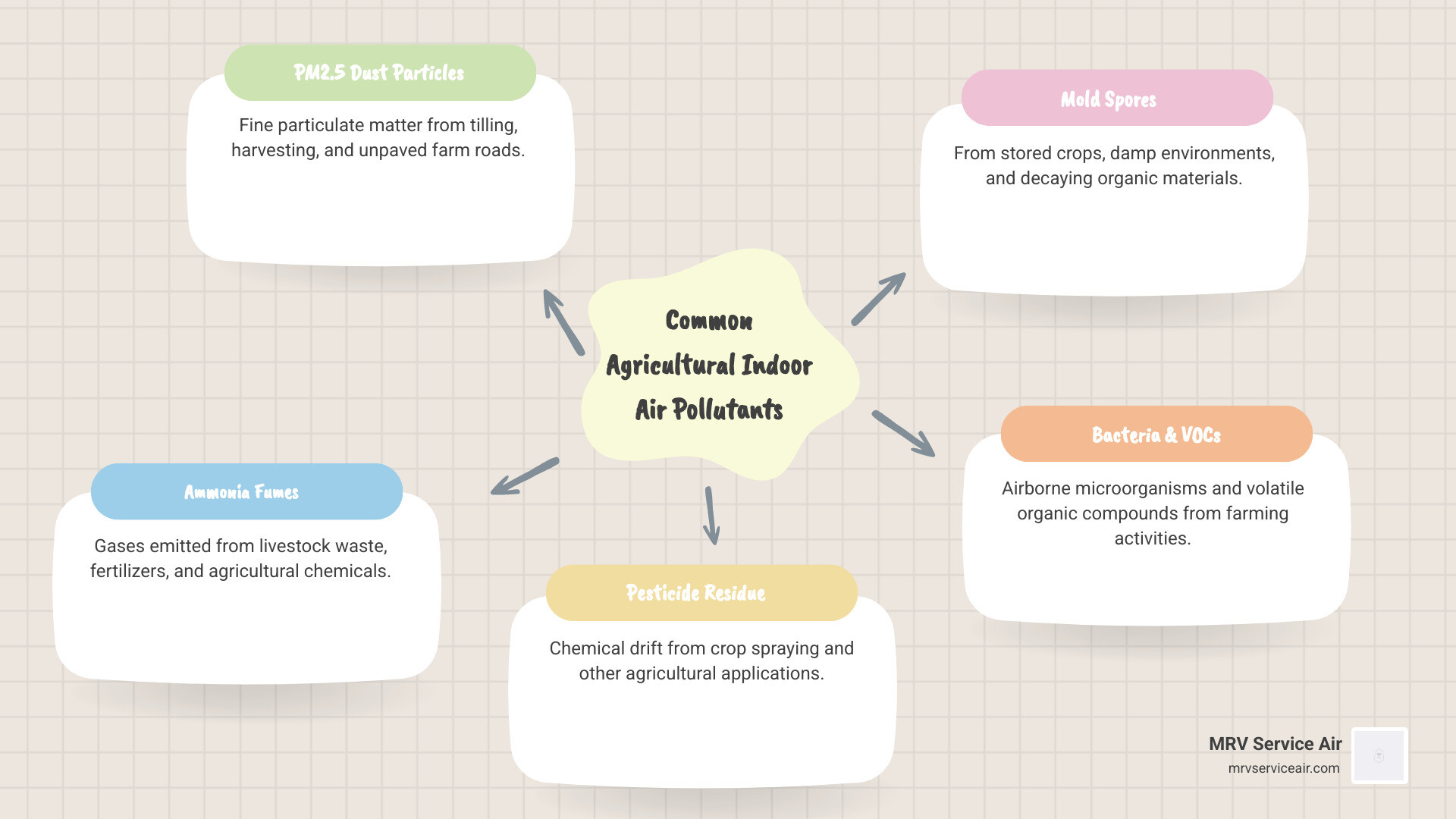
When we talk about how to improve indoor air quality in agricultural areas, we first have to know what we’re fighting. In Delano and the surrounding Central Valley, the air isn’t just “dusty”—it’s a complex cocktail of biological and chemical particles.
Particulate Matter (PM2.5 and PM10)
Dust is the most visible offender. Between tilling, harvesting, and heavy machinery moving over unpaved roads, rural air is often thick with “crustal dust.” However, the real danger lies in PM2.5—fine particles that are 2.5 microns or smaller. These are small enough to bypass your body’s natural filters (your nose and throat) and lodge deep in your lungs or even enter your bloodstream.
Chemical and Gaseous Threats
If you live near livestock, you’re familiar with the sharp scent of ammonia. Beyond being unpleasant, ammonia fumes and Volatile Organic Compounds (VOCs) from fertilizers and pesticides can cause significant respiratory irritation. In fact, livestock facilities are known to produce a wide range of odor-causing compounds and fumigants that don’t just stay in the barn—they drift toward your home.
Biological Contaminants
Agriculture is a living industry, which means biological “hitchhikers” are everywhere. Bacteria counts in rural areas can be surprisingly high. Research shows that outdoor air can carry up to 1,500 bacteria per cubic meter. When you add mold spores like Botrytis (gray mold) or powdery mildew—common in both greenhouses and open fields—you have a recipe for indoor allergies and sinus issues.
Combustible Dust and Wildfire Smoke
For those near mills or processing plants, combustible dust (from flour, cornstarch, or grain) is a serious safety concern. Furthermore, as we’ve seen in recent years, wildfire smoke has become a seasonal staple in California. This smoke contains carbon monoxide, nitrogen oxides, and organic hazardous compounds that are even more harmful than standard industrial pollution.
Because 58.8% of U.S. counties lack official air quality monitoring systems—affecting nearly 50 million people—rural residents often have to be their own first line of defense. This is where More info about indoor air quality services becomes essential for local families. Understanding your home’s unique layout is the first step, which is why we often recommend More info about planning and design to ensure your HVAC system is built to handle these specific rural loads.
How to Improve Indoor Air Quality in Agricultural Areas with High-Efficiency Filtration
Filtration is the “heavy lifter” of indoor air quality. In a city, a basic hardware store filter might suffice. In an agricultural zone, you need professional-grade equipment.
The Power of MERV 11 and HEPA
The Minimum Efficiency Reporting Value (MERV) tells you how well a filter captures particles. For most rural homes, a MERV 11 filter is the “sweet spot.” It is specifically rated to remove particles the size of mold spores and is highly effective against the common pathogens found in indoor farming and greenhouses.
However, if you have family members with asthma or severe allergies, or if you are dealing with virus-sized particles (like the PRRS virus which plagues the swine industry), HEPA (High-Efficiency Particulate Air) filters are the gold standard. HEPA filters are designed to capture 99.97% of particles as small as 0.3 microns.
Activated Carbon and Gaseous Adsorbers
Standard filters stop “stuff,” but they don’t stop “smells.” To combat ammonia from livestock or VOCs from pesticide applications, you need activated carbon or gaseous adsorber filters. These filters use a process called adsorption to trap gas molecules on a bed of charcoal, neutralizing odors before they reach your living room.
Using these high-performance filters can also help with More info about energy efficiency services. While it seems counterintuitive, a properly designed high-efficiency system ensures your HVAC doesn’t have to work overtime to push air through a clogged, low-quality filter, ultimately saving you money on utilities.
Filter Effectiveness Comparison
| Filter Type | Particle Capture Size | Best For… |
|---|---|---|
| Standard (MERV 1-4) | >10 microns | Protecting the HVAC equipment only |
| MERV 11 | 1.0 – 3.0 microns | Dust, mold spores, pet dander, agricultural dust |
| MERV 13-16 | 0.3 – 1.0 microns | Bacteria, smoke, fine droplets |
| HEPA | 0.3 microns | Viruses, ultra-fine PM2.5, severe allergy relief |
| Activated Carbon | Molecular level | Ammonia, odors, VOCs, pesticide fumes |
Selecting the Right Filters for How to Improve Indoor Air Quality in Agricultural Areas
Choosing a filter isn’t just about the highest number; it’s about what your system can handle. A HEPA filter is very dense, and if your furnace fan isn’t powerful enough, it can actually “strangle” your system.
When we perform More info about furnace services, we check the static pressure of your system to see which high-efficiency filter will provide the best protection without causing a breakdown. In agricultural areas, we generally recommend a “staged” approach: a sturdy pre-filter to catch the big dust clouds, followed by a MERV 11 or 13 filter for the fine particles.
Maintenance Tip: In Delano, the standard “change every 3 months” rule often doesn’t apply. During harvest season or high-wind events, you might need to change your filters every 30 days. A clogged filter is not only useless for air quality but is the leading cause of blower motor failure.
Using Complementary Tech for How to Improve Indoor Air Quality in Agricultural Areas
While filters are great at catching particles, they don’t always “kill” what they catch. That’s where complementary technology comes in.
- UV-C Lights: These are installed inside your ductwork or near the cooling coils. They use ultraviolet radiation to denature the DNA of mold, bacteria, and viruses. This is the same tech used in high-end greenhouses to prevent Botrytis outbreaks.
- Smart Sensors: You can’t manage what you can’t measure. Modern IAQ monitors track PM2.5, CO2, and humidity in real-time. If the neighbor is tilling their field and the dust levels spike, your sensor can automatically tell your HVAC system to ramp up the filtration.
- Humidity Control: Mold loves moisture. In agricultural areas where irrigation can lead to high local humidity, keeping your home between 30% and 50% humidity is vital. We often integrate dehumidifiers with More info about ventilation work to ensure your air stays crisp and dry.
Optimizing Ventilation and Sealing for Farmhouse Protection
If your home is “leaky,” even the best air purifier in the world will struggle to keep up. In rural areas, “source control” and “sealing” are your best friends.
The “Envelope” Strategy
Think of your home as a pressurized cabin. If you have gaps around your windows, doors, or attic hatches, the wind will push agricultural dust and pesticides right into your living space.
- Weatherstripping: A simple, cost-effective weekend project that can reduce indoor dust by up to 30%.
- Positive Pressure: By using a specialized ventilation system, we can slightly “overfill” your home with filtered air. This creates positive pressure, meaning when you open the door, air blows out rather than sucking dusty outdoor air in.
Advanced Ductwork and Fresh Air Intake
Your ducts are the lungs of your home. If they have leaks, they might be pulling “dirty” air from your crawlspace or attic and blowing it into your bedroom. Our More info about duct work services focus on sealing these leaks so that 100% of the air moving through your home has passed through your high-efficiency filters.
For modern, tightly-sealed homes, you still need fresh air to prevent CO2 buildup. We recommend Energy Recovery Ventilators (ERVs). These systems bring in fresh outdoor air but pass it through a high-efficiency filter and a heat exchanger first. This gives you the benefits of an open window without the dust, pollen, or heat loss. This is a core part of our More info about central HVAC services for rural residents who want the best of both worlds.
Frequently Asked Questions about Rural Air Quality
What are the primary sources of indoor air contaminants in agricultural areas?
The big ones are “crustal dust” (soil particles), ammonia from animal waste, pesticide/herbicide drift, and biological growth like mold spores and bacteria. In the Central Valley, wildfire smoke and harvesting debris also contribute significantly to the indoor pollutant load.
How often should I change my air filters if I live near a farm?
While the manufacturer might say every 90 days, we recommend checking your filters every 30 days during the peak California growing and harvest seasons. If the filter looks gray or “fuzzy,” it’s time for a change. High-volume agricultural dust can clog a filter much faster than standard city smog.
Can indoor plants effectively clean the air in a rural home?
NASA research suggests that certain plants (like snake plants or peace lilies) can help remove VOCs like formaldehyde and benzene. The general rule is one plant per 100 square feet. While they won’t replace a MERV 11 filter for stopping dust or ammonia, they are a great “natural” supplement to a mechanical filtration system.
Conclusion: Breathing Easier in Delano
At MRV Service Air, we know that living in a rural area shouldn’t mean compromising on the air you breathe. Whether you’re managing a large-scale agricultural facility or just trying to keep your family healthy in a farmhouse near Delano, the right combination of high-efficiency filtration, smart monitoring, and professional HVAC maintenance makes all the difference.
Improving your indoor air quality isn’t just about comfort—it’s about protecting your long-term health and the efficiency of your home’s most expensive equipment. We are proud to serve the Delano community with prompt, quality service at prices that make sense for our neighbors.
Ready to clear the air? From professional IAQ assessments to installing the latest in HEPA and UV-C technology, our team is here to help. Restore your comfort with expert AC service in Delano and take the first step toward a cleaner, healthier home today.