







How Long Does an AC Really Last in the Central Valley?
The average lifespan of an AC in the Central Valley is shorter than the national standard — and if you own a home or small business in the area, that’s something worth knowing before your system fails on a 108°F August afternoon.
Most central AC units last 15 to 20 years nationally with proper maintenance. But in the Central Valley, where summers push triple digits for weeks at a time, that window narrows. Realistically, most homeowners here should plan for 13 to 17 years — sometimes less if the system has been neglected or was poorly installed to begin with.
Here’s a quick breakdown:
| Condition | Expected Lifespan |
|---|---|
| National average (well-maintained) | 15-20 years |
| Central Valley (well-maintained) | 13-17 years |
| Central Valley (older model, minimal maintenance) | 10-12 years |
| Central Valley (modern high-efficiency, excellent care) | Up to 17-20 years |
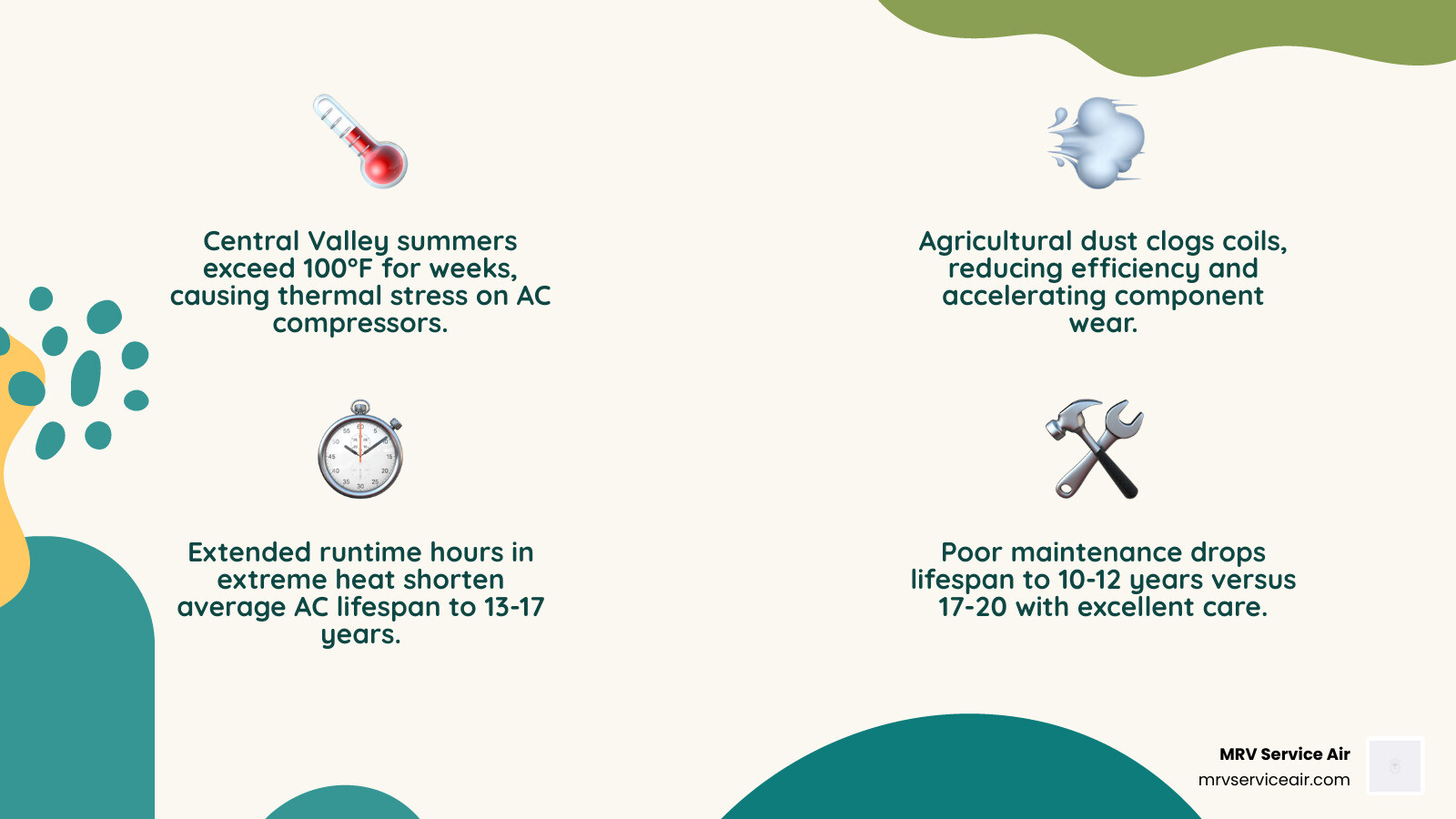
The reason comes down to two things the Central Valley has in abundance: extreme heat and agricultural dust. Your AC doesn’t just cool your home — it fights through 100°F+ days, thick particulate air, and more annual runtime hours than units in cooler parts of California ever face. That constant workload accelerates wear on every moving part.
In the sections below, we’ll walk through exactly what cuts AC life short in this region, the warning signs to watch for, and what you can do to get the most years out of your system.
Understanding the Average Lifespan of an AC in the Central Valley

When we talk about the average lifespan of an AC in the Central Valley, we have to look at the regional reality versus the national marketing. While a manufacturer might tell you their unit lasts two decades, those estimates are often based on moderate climates where the AC only runs a few months out of the year.
In Delano and the surrounding areas, our cooling season starts early and ends late. We aren’t just dealing with a few weeks of heat; we are dealing with a marathon of high-demand cooling. This heavy usage means your system might hit its “mechanical age” much faster than a unit in Northern California or the Midwest. For a deeper look at keeping your system running during these peak times, check out our AC service options.
Impact of Triple-Digit Summers on the Average Lifespan of an AC in the Central Valley
Triple-digit summers are the ultimate endurance test for HVAC equipment. When the mercury hits 100°F or higher, the temperature difference between the scorching outdoor air and your desired 72°F indoor setting creates massive thermal stress.
The heat forces the compressor to work harder and run longer cycles to move heat out of your home. Instead of cycling on and off efficiently, units in the Valley often run for hours at a time. This constant operation leads to component fatigue, specifically in the fan motors and capacitors, which are often the first parts to fail under the strain of a Central Valley July.
Regional Environmental Factors
It isn’t just the heat that’s the enemy; it’s what’s in the air. The Central Valley is an agricultural powerhouse, which means our air is often filled with dust, pollen, and fine particulates. These particles act like a blanket on your outdoor condenser coils.
When dust builds up, it prevents the coils from releasing heat effectively. This forces the system to run even hotter, accelerating the breakdown of internal lubricants and causing “coil corrosion.” Over time, this buildup doesn’t just lower efficiency—it can lead to pinhole leaks in the refrigerant lines. Maintaining your indoor air quality is just as important for your equipment’s health as it is for your own lungs.
Crucial Factors That Influence System Durability
Not all AC units are created equal, and how they are treated throughout their lives makes a world of difference. As we move through 2026, technology has improved, but the basics of physics still apply.
| Feature | Older R-22 Models | Modern R-410A / R-32 Systems |
|---|---|---|
| Typical Lifespan | 10-12 years (in the Valley) | 15-20 years (with care) |
| Refrigerant Status | Phased out / High repair cost | Current Standard / More efficient |
| Efficiency (SEER2) | Usually below 10 | 14.3 to 20+ |
| Durability | Heavy-duty but inefficient | Advanced protection / Variable speed |
Installation quality is perhaps the most underrated factor. A high-end unit installed poorly will fail faster than a budget unit installed by experts. Proper sizing, duct matching, and refrigerant charging are essential. If you are looking for professional guidance, our HVAC contractor services ensure your system starts its life on the right foot.
Thermostat settings also play a huge role. If you keep your home at a chilly 70°F when it’s 110°F outside, your unit may never stop running. Setting the thermostat to 78°F—the Department of Energy’s recommendation—can significantly reduce mechanical wear and extend the average lifespan of an AC in the Central Valley.
Maintenance and the Average Lifespan of an AC in the Central Valley
We cannot stress this enough: maintenance is the number one variable you can control. A neglected system in our climate is lucky to see 10 years. A well-maintained one can easily cruise past 15.
Annual tune-ups allow us to catch small issues like a bulging capacitor or a slightly clogged drain line before they turn into a system-killing compressor failure. Simple tasks like regular filter replacements prevent the evaporator coil from freezing up and putting back-pressure on the heart of your system. Explore our central HVAC services to see how a pro tune-up works.
System Sizing and Features
In the past, many contractors followed the “bigger is better” philosophy. In the Central Valley, an oversized unit is a recipe for a short lifespan. Oversized units “short-cycle,” meaning they turn on and off rapidly. This puts immense strain on the compressor and never allows the system to properly dehumidify the air.
Modern features like variable-speed motors are game-changers for our region. These motors can slow down or speed up based on the cooling demand, which reduces the number of hard starts and stops. When you are planning and designing a new system, choosing these high-efficiency features can add years to the unit’s life.
Signs Your Valley AC is Nearing the End of Its Useful Life
How do you know if your unit is just having a “bad day” or if it’s time to say goodbye? In our experience, there are a few “Valley-specific” warning signs.
- Rising Energy Bills: If your utility bills are skyrocketing compared to the same month last year (and the weather hasn’t changed drastically), your unit is likely losing its efficiency. It’s working harder to produce the same amount of cool air.
- Frequent Repairs: If you’ve seen your HVAC technician more than twice in the last two years for repairs, you’re likely throwing good money after a failing system.
- Weak Airflow: Dust buildup in the ducts or a failing blower motor can lead to “hot spots” in your home where the air just doesn’t seem to reach.
- Strange Noises: Grinding, squealing, or heavy rattling often points to mechanical failure in the motor or compressor.
Keeping an eye on these signs is part of managing your home’s energy efficiency.
The Repair vs. Replace Dilemma
A common rule of thumb is the “$5,000 Rule.” Multiply the age of your unit by the cost of the repair. If the total exceeds $5,000, it’s usually time to replace. For example, a 12-year-old unit needing a $500 repair (12 x 500 = 6,000) is a candidate for replacement.
Furthermore, if your unit still uses R-22 (Freon), repairs involving the refrigerant are becoming prohibitively expensive due to environmental phase-outs. Since the furnace often works in tandem with the AC, we sometimes recommend looking at furnace services simultaneously to ensure the whole system is compatible and efficient.
Modern Solutions for Extreme Heat
If your old central air unit is struggling, 2026 offers some incredible alternatives. Heat pumps have become incredibly efficient even in high-heat environments. They offer both heating and cooling in one package. Check out our heat pump services to see if this fits your home.
For homes with specific “hot rooms” or those without existing ductwork, mini-split HVAC systems provide targeted, high-efficiency cooling that can take the pressure off your main system.
Practical Tips to Extend Your AC’s Life in 2026
You don’t have to be an HVAC expert to help your system last longer. Here are some actionable steps for 2026:
- Create Shade: If your outdoor unit is in direct afternoon sun, consider a lattice or shade structure. Just make sure there is at least 2-3 feet of clearance for airflow.
- Debris Removal: After a windstorm or during harvest season, check your outdoor unit. Clear away leaves, tumbleweeds, and dust.
- Duct Sealing: Leaky ducts can waste 20-30% of your cooled air before it even reaches your rooms, forcing the AC to run longer. Professional duct work can fix this.
- Filter Discipline: In the Valley, a “90-day filter” is often a “30-day filter.” Check it monthly during the summer.
Optimizing Airflow and Ventilation
Your AC doesn’t live in a vacuum. The state of your attic and your home’s “envelope” dictates how hard the AC has to work. Adding attic insulation or improving ventilation work keeps the heat from seeping into your living space in the first place. Smart thermostats can also help by gradually cooling the home before you arrive, rather than forcing a “crash cool” when you get home at 5 PM.
Proactive Component Care
Think of your AC like a car. You wouldn’t drive 50,000 miles without an oil change. Proactive care involves checking refrigerant levels (too much or too little can kill a compressor) and testing capacitors. These small electrical components often fail during heatwaves; replacing them early saves the motor they support. Don’t forget to look at our specials and rebates to make this proactive care even more affordable.
Frequently Asked Questions about AC Longevity
Can an AC unit in the Central Valley last 30 years?
While we’ve seen some “legendary” units from the 1990s still kicking, it is extremely rare in our climate. Even if it does run, a 30-year-old unit is likely costing you three times more in electricity than a modern unit. Mechanical limits and the lack of replacement parts usually make 15-20 years the practical ceiling for the average lifespan of an AC in the Central Valley.
How often should I change my filters during harvest season?
During peak harvest, the dust levels in Delano and surrounding areas can be intense. We recommend inspecting your filters every 3 weeks. If you can’t see the material of the filter through the dust, change it. Airflow restriction is a leading cause of frozen coils and “slugging” the compressor.
Are ductless systems more durable in hot climates?
Ductless systems are very durable because they use advanced inverter technology. This allows them to run at very low power levels most of the time, rather than the “all or nothing” approach of older central units. They also avoid the energy loss associated with dusty, leaky ducts. You can learn more about ductless HVAC and how it handles our heat on our dedicated service page.
Conclusion
At MRV Service Air, we’ve lived and worked in the Delano community long enough to know that a broken AC isn’t just an inconvenience—it’s a safety issue. Understanding the average lifespan of an AC in the Central Valley helps you stay ahead of the heat.
By prioritizing maintenance, choosing the right modern features, and keeping an eye on those warning signs, you can ensure your home stays a sanctuary of cool air for years to come. Whether you need a quick tune-up or are looking at new heating systems and cooling solutions, our team is here to provide prompt, quality service at prices that make sense for Valley families. Give us a call today and let’s make sure your AC is ready for whatever the Valley throws at it!