







Why Every Dusty Climate Home Needs the Right Air Filter
If you’re looking for an air filter guide for dusty climate homes, here’s what you need to know upfront:
Quick Answer: Best Air Filters for Dusty Climate Homes
| Priority | What to Look For |
|---|---|
| MERV Rating | MERV 13 (captures 98% of particles down to 0.3 microns) |
| Filter Type | Pleated, electrostatic-charged synthetic media |
| Thickness | 4-inch filters preferred for high-dust loads |
| Replace Every | 30 to 45 days in dusty or arid climates |
| Extra Steps | Seal entry points, HEPA vacuum weekly, check monthly |
Living near farmland in a place like Delano, CA means dust is not just a nuisance — it is a daily reality. Wind picks up fine soil particles from harvested fields, unpaved roads stir up clouds of grit, and before long, that particulate matter is working its way into your home through every gap and HVAC return vent it can find.
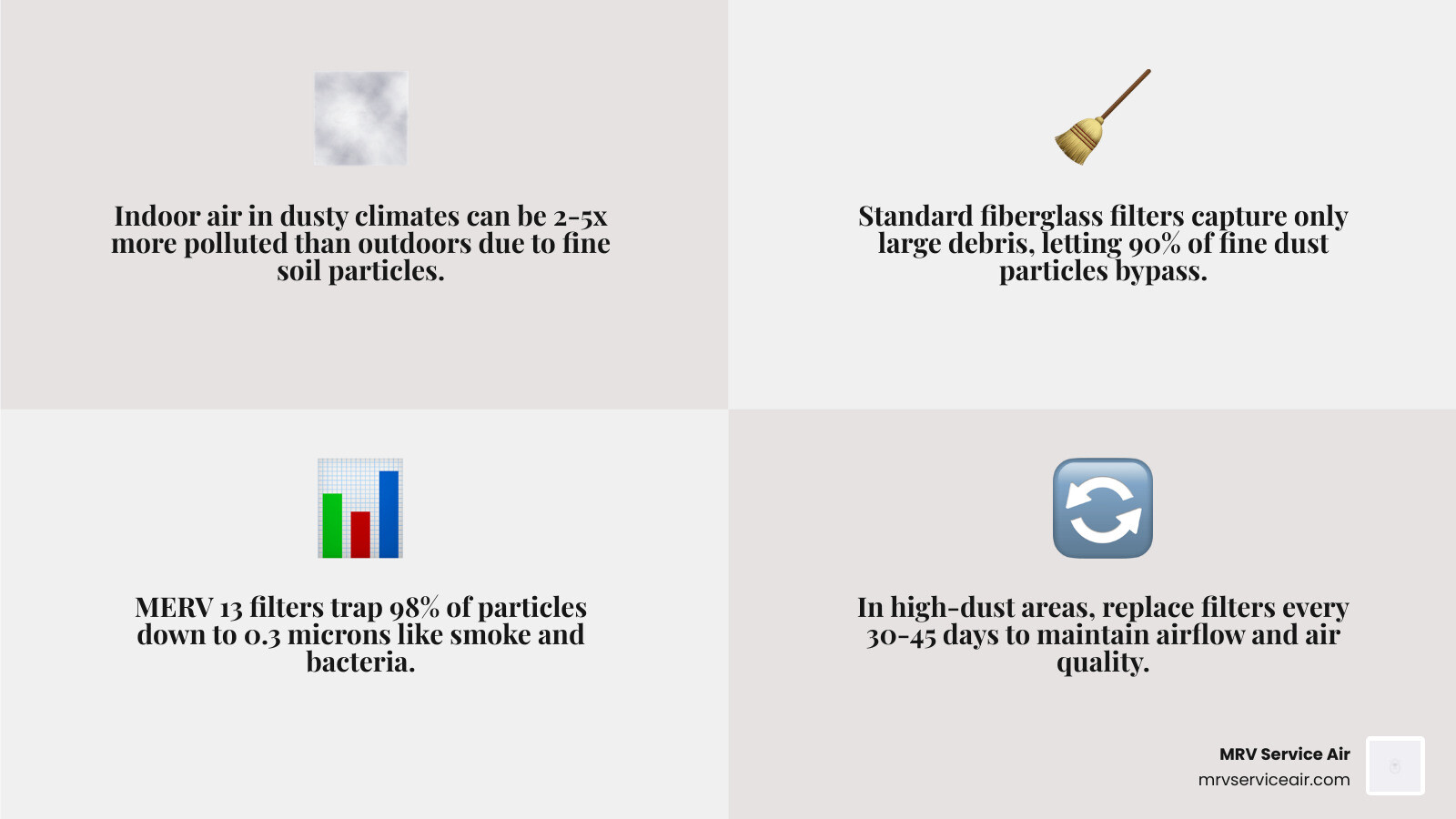
The EPA estimates that indoor air pollutant concentrations can run two to five times higher than typical outdoor levels. In an agricultural region with dry, windy conditions, that gap can be even wider. Most people spend around 90% of their time indoors, which means the air quality inside your home matters far more than most homeowners realize.
A standard fiberglass filter simply was not designed for this kind of environment. It clogs fast, lets fine particles slip through, and can leave your family breathing air that is far from clean — all while quietly straining your HVAC system in the background.
The good news is that choosing the right filter, and maintaining it properly, can make a real difference. This guide walks you through exactly what to look for.
Why Standard Filters Fail in Dusty Climates
If you have ever pulled a standard fiberglass filter out of your intake vent after a particularly windy week in Delano, you know the “gray wall” effect. These basic filters, often costing only a few dollars, are essentially “rock catchers.” They are designed to stop large debris—like literal pebbles or giant clumps of pet hair—from hitting your HVAC coils, but they do almost nothing to improve your indoor air quality.
In a dusty climate, fiberglass filters fail for two main reasons:
- Particle Bypass: Because the fibers are spaced far apart, fine agricultural dust and silty soil particles sail right through the filter and back into your living space.
- Rapid Clogging: Despite letting the small stuff through, the larger particles coat the surface quickly. Once a fiberglass filter is “loaded,” it creates massive airflow resistance, forcing your blower motor to work twice as hard to pull air through a literal blanket of dirt.
For homeowners concerned about their health and equipment, looking into more info about indoor air quality services is a smart first step. Upgrading to a pleated filter provides significantly more surface area, allowing the filter to trap more dust without immediately suffocating your air conditioner.
The Impact of Local Agriculture and Wind on Indoor Air
In April 2026, as we move through the spring season, wind patterns in the Central Valley become a major factor in home maintenance. Agriculture is the lifeblood of our region, but the mechanical harvesting and tilling of soil release vast amounts of fine particulate matter.
These soil particles are often smaller than 10 microns (PM10), and many are smaller than 2.5 microns (PM2.5). These tiny invaders are light enough to stay airborne for days and small enough to penetrate deep into the lungs. Without proper ventilation work, these outdoor pollutants infiltrate through window seals and door frames, settling on your furniture and recirculating through your ducts.
Finding the Best Air Filter Guide for Dusty Climate Homes
When selecting a filter, you’ll encounter three different rating systems: MERV, MPR, and FPR. While they all measure how well a filter captures particles, the industry standard is MERV (Minimum Efficiency Reporting Value).
| Rating System | Scale | Who Uses It? |
|---|---|---|
| MERV | 1 to 16 | Industry Standard (ASHRAE) |
| MPR | 300 to 2800 | 3M / Filtrete |
| FPR | 4 to 10 | Home Depot |
For dusty climates, we recommend a pleated design with an electrostatic charge. Unlike flat fiberglass, pleated filters use a “V” shape to increase the surface area of the media. This means the filter can hold a much larger volume of agricultural dust before it needs to be changed. The electrostatic charge acts like a magnet, pulling in fine dust particles that would otherwise pass through the mesh. If your current system is struggling to keep up with the dust, it might be time for more info about AC services to ensure your unit is optimized for higher-efficiency filtration.
Why MERV 13 is the Gold Standard for Dust Control
In residential HVAC, MERV 13 is widely considered the “sweet spot” for dusty environments. While lower ratings (like MERV 8) catch lint and dust mites, MERV 13 is capable of capturing 98% of particles, including bacteria, smoke, and microscopic allergens as small as 0.3 microns.
Using a MERV 13 filter is especially beneficial for heating systems during the cooler months when the house is sealed tight. It provides a level of protection that rivals high-end air purifiers but works through your entire home’s ductwork. This high-efficiency media ensures that even the finest silt from nearby fields doesn’t end up in your carpets or your lungs.
Comparing MERV, MPR, and FPR in an Air Filter Guide for Dusty Climate Homes
It can be confusing when you’re standing in a hardware store aisle looking at different numbers. Here is a quick breakdown to help you translate:
- MERV 13 is roughly equivalent to an MPR 1500-1900 or an FPR 10.
- MERV 11 is roughly equivalent to an MPR 1000-1200 or an FPR 7.
While 3M’s MPR and Home Depot’s FPR are helpful for their specific brands, always look for the MERV rating on the side of the frame for a true industry benchmark. If you are unsure which rating your specific furnace can handle, seeking more info about furnace services can prevent you from accidentally installing a filter that is too restrictive for your blower motor.
Balancing Filtration with HVAC System Health
There is a common myth that “higher is always better” when it comes to MERV ratings. However, higher-rated filters are denser, which can increase static pressure. Think of it like trying to breathe through a thick wool sweater while running a marathon—your lungs (the blower motor) have to work much harder.
If a filter is too restrictive for your specific system, it can lead to:
- Short-cycling: The system overheats and shuts off before the house is cool.
- Frozen Coils: Restricted airflow causes the temperature of the coils to drop too low.
- Reduced Longevity: Your blower motor may burn out years earlier than expected.
To avoid these issues, regular central HVAC services are essential. A technician can measure the “pressure drop” across your filter to ensure your system is breathing easily while still cleaning the air.
Avoiding Airflow Restriction in High-Dust Environments
One of the best ways to get high filtration without killing your airflow is to increase the filter thickness. If your home is currently set up for a 1-inch filter, you might consider having a professional modify the cabinet to accept a 4-inch media filter.
A 4-inch filter has significantly more surface area than a 1-inch filter. This allows for a high MERV rating (like MERV 13) with a much lower pressure drop. It’s a fantastic upgrade for heat pump services and traditional split systems alike. Not only does it protect your equipment, but these thicker filters often only need to be changed every 6 to 12 months in “normal” climates—though in our dusty region, you’ll still want to check them more often.
Maintenance Strategies for Arid and Windy Regions
In a place like Delano, the “change every 90 days” rule on the filter box is often a recipe for disaster. During peak agricultural seasons or high-wind events, a filter can become fully loaded in as little as three weeks.
We recommend a 30-day inspection cycle. Set a recurring reminder on your phone for the first of every month. Pull the filter out and perform the “light test”—hold it up to a bright light or the sun. If you can’t see light passing through the pleats, it’s time for a change.
Complementary maintenance is also key. Keeping your duct work clean and ensuring your home is well-sealed will reduce the load on your filter. Check the weather stripping around your doors and windows; if you can feel a breeze, dust is getting in.
Essential Air Filter Guide for Dusty Climate Homes Maintenance
To keep your home a sanctuary from the Central Valley dust, follow this April 2026 checklist:
- Switch to “Auto” Fan Settings: While running the fan “On” constantly filters more air, it also pulls in more outdoor dust through tiny leaks in your return ducts. Use “Auto” to balance filtration and infiltration.
- Seal Entry Points: Use high-quality door sweeps and caulk around window frames.
- Upgrade to HEPA Vacuuming: Standard vacuums often blow fine dust right back out the exhaust. A HEPA-certified vacuum traps those particles.
- Consider Ductless Options: For room-specific dust control, ductless HVAC systems often have multi-stage filtration that is very effective for localized air cleaning.
Frequently Asked Questions about Dust Control
What causes excessive dust buildup in homes near farms?
Agricultural activities are the primary culprit. Tilling, harvesting, and even the movement of heavy machinery on unpaved access roads kick up fine silt and organic matter. High winds common in arid regions then transport these particles, which enter your home through “envelope leaks”—small gaps in doors, windows, and even electrical outlets.
How often should I change my filter in a dusty climate?
In a dusty or windy environment, you should replace your air filter every 30 to 45 days. While 90 days is the standard recommendation for average suburban homes, the high volume of particulate matter in agricultural areas clogs the filter media much faster, which can lead to system strain and poor air quality.
Can a high MERV filter damage my older HVAC unit?
It is possible. Older HVAC systems were often designed for low-resistance fiberglass filters. Installing a dense MERV 13 filter can cause the blower motor to work outside its intended parameters, leading to overheating or failure. Before upgrading, it is always best to have a professional assess your system’s static pressure capacity.
Conclusion
At MRV Service Air, we understand that living in Delano means fighting a constant battle against the elements. Dust doesn’t just make your furniture look dirty; it impacts your health and the lifespan of your most expensive home appliance. By following this air filter guide for dusty climate homes, you can take control of your indoor environment.
From professional HVAC maintenance to expert planning and design for high-efficiency filtration systems, our team is here to help you breathe easier. Don’t let agricultural dust dictate your home’s comfort level.
Schedule your high-efficiency filter consultation today and let us help you find the perfect balance between clean air and a healthy HVAC system.