







Is Your AC Going Bad? Here’s How to Tell Before It Breaks Down Completely
How to know if your ac is going bad comes down to a handful of clear warning signs most homeowners can spot without any tools.
Quick answer — your AC may be going bad if you notice:
- Warm air blowing from vents even when the thermostat is set to cool
- Weak or reduced airflow from one or more vents
- Unusual noises like grinding, squealing, or hissing
- Short cycling — the unit turns on and off more frequently than normal
- Rising energy bills with no clear explanation (a 15–20% spike is a red flag)
- Water leaking around the indoor unit or a full drain pan
- Musty or burning smells coming from the vents
- Ice or frost forming on the outdoor unit or refrigerant lines
Most residential AC systems are built to last 10 to 15 years with regular maintenance. But in a place like Delano, where summer heat pushes systems hard for months at a time, problems can show up well before that deadline. The worst part? Many of the early warning signs are easy to miss — until the system stops working entirely on the hottest day of the year.
The good news is that catching these signs early almost always means a simpler, less expensive fix. This guide walks you through exactly what to look for so you can act before a small problem becomes a full breakdown.
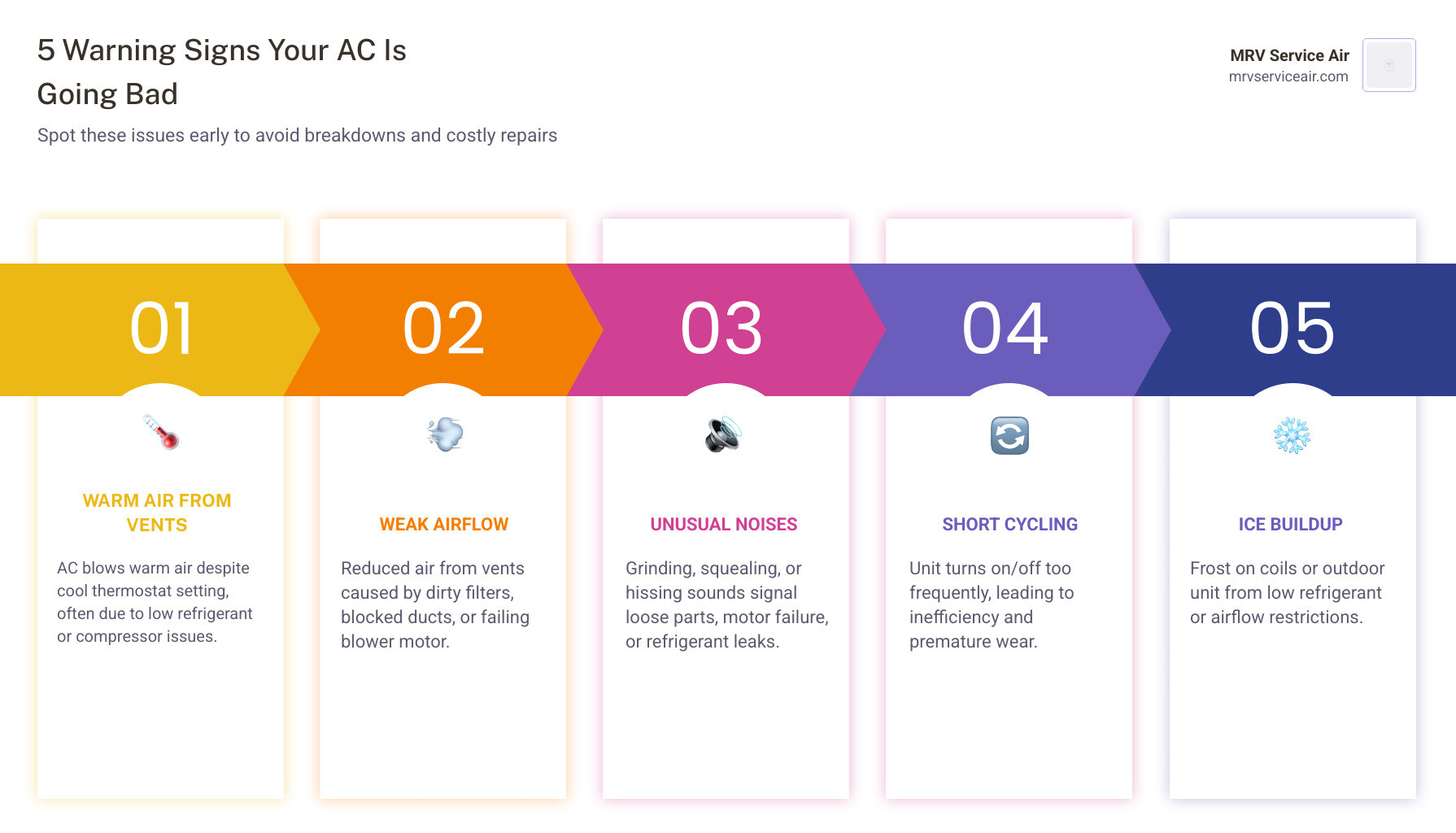
5 Warning Signs of how to know if your ac is going bad
When the heat hits Central California or the humid stretches of Central Iowa, your air conditioner becomes the most important appliance in your home. We often take it for granted until that first afternoon when the living room feels a bit “stuffy.” Recognizing the early warning signs is the difference between a quick tune-up and a total system replacement.
One of the most visual signs is ice buildup on the outdoor condenser unit. You might think, “Hey, it’s an air conditioner, ice is good!” Unfortunately, it’s quite the opposite. Ice on your unit indicates a serious restriction in airflow or a lack of refrigerant, both of which force your system to work overtime until it eventually quits.
Beyond ice, pay close attention to how the air feels. If you’re feeling warm air or noticing that the house never quite reaches the temperature set on the thermostat, your system is struggling. Weak airflow is another silent performance killer. If you hold your hand up to a vent and it feels like a gentle whisper instead of a steady breeze, there is an internal blockage or a failing blower motor.
Short cycling is another major red flag. This happens when your AC turns on, runs for a few minutes, and then abruptly shuts off, only to start again moments later. This constant “on-off” cycle puts immense mechanical strain on the compressor. If you’re seeing these issues, it’s time to look into central HVAC services to diagnose the root cause before the compressor burns out.
Sometimes the issue isn’t the mechanical unit at all, but the “brain” of the operation—the thermostat. If your screen is blank, unresponsive, or showing temperatures that don’t match the actual feel of the room, it could be miscommunicating with your AC unit.
Common Airflow Obstructions to Check:
- Extremely dirty or “clogged” air filters
- Furniture or curtains blocking return air grilles
- Closed or blocked supply vents in unused rooms
- Accumulation of pet hair and dust in the ductwork
- Debris like tall grass, leaves, or sticks surrounding the outdoor condenser
Recognizing Warm Air: how to know if your ac is going bad
There is nothing more frustrating than standing under a vent during a Delano heatwave and feeling air that is lukewarm at best. When your system starts blowing warm air, it usually points to a few specific culprits.
First, your refrigerant levels might be low. Refrigerant is the “blood” of your AC system; it flows through the coils, changing from liquid to gas to absorb heat from your home and dump it outside. If there is a leak, the system loses its ability to transfer heat. Because refrigerant is under high pressure, even a tiny pinhole can lead to a rapid loss of cooling power.
Second, you could be looking at a failing compressor. The compressor is the heart of the system. It pressurizes the refrigerant so it can circulate. If the compressor is going bad, it won’t be able to move the refrigerant effectively, leading to warm air distribution throughout your home. In some cases, especially with modern energy-efficient setups, this could involve your heat pump services, as these units handle both heating and cooling tasks.
A professional technician will often use a temperature differential test to diagnose this. Ideally, the air coming out of your evaporator coil should be about 18 degrees Fahrenheit cooler than the air entering the system. If that “drop” is significantly less, your system is failing to remove heat.
Using Energy Bills to how to know if your ac is going bad
Your wallet often knows your AC is failing before you do. As of April 2026, utility rates continue to be a significant part of the household budget, and an inefficient AC is the fastest way to see those costs skyrocket.
When an air conditioner is “going bad,” its mechanical efficiency drops. This means it has to run longer and consume more electricity to achieve the same level of cooling it once did with ease. We recommend homeowners monitor their utility statements closely. If you notice a 15–20% spike in your energy bill compared to the same month last year—without a corresponding record-breaking heatwave—your AC is likely under mechanical strain.
This strain often comes from parts that are wearing out, such as a capacitor that is struggling to start the motor or a fan that is dragging due to lack of lubrication. By investing in energy efficiency services, you can identify these “energy vampires” early. An AC that runs constantly because it can’t reach the set temperature is a system that is headed for a premature grave.
Understanding Unusual Noises and Smells
Your AC should be seen and felt, but rarely heard. While every unit makes a low-level hum when it kicks on, any new or “loud” sounds are your system’s way of screaming for help.
- Grinding: This usually indicates that the bearings in your fan motor are shot. If you hear this, turn the system off immediately to prevent the motor from seizing.
- Squealing: This is often a sign of a slipping belt or a motor that needs lubrication. It’s common in older units but shouldn’t be ignored.
- Hissing: This is the tell-tale sound of a refrigerant leak. Since refrigerant is under pressure, it makes a distinct whistling or hissing noise as it escapes the coils.
- Clicking: If you hear rapid clicking when the unit tries to start, it’s likely an electrical issue, such as a failing relay switch or a capacitor that can’t hold a charge.
Smells are just as telling. If you notice a musty odor, it’s a sign that moisture is accumulating somewhere it shouldn’t, leading to microbial growth or mold. This is a major concern for indoor air quality. On the other hand, a “burning” or “ozone” smell is an emergency. This indicates that electrical wiring is overheating or a motor is burning out. If you smell smoke or burning plastic, shut the power off at the breaker and call us immediately.
Moisture and Ice: Visible Signs of System Failure
Air conditioners naturally produce condensation as they remove humidity from your home. However, that water should always stay contained within the system and flow out through the designated drain line. If you see water pooling around your indoor air handler or a drain pan that is overflowing, you have a problem.
Clogged condensate drains are a frequent issue. Dust and algae can build up in the pipe, causing water to back up and spill over. This not only risks water damage to your home but can also trigger safety switches that shut your whole system down. In some cases, poor duct work can also contribute to moisture issues if the air isn’t moving correctly, leading to “sweating” ducts and potential mold growth.
Then there’s the ice. As we mentioned earlier, ice formation is a major red flag. It usually happens when the evaporator coil gets too cold because there isn’t enough air blowing over it (due to a dirty filter) or because the refrigerant level is so low that the coil’s temperature drops below freezing.
| Sign | Probable Cause | Urgency |
|---|---|---|
| Water pooling on floor | Clogged drain line or cracked pan | Moderate – Risk of water damage |
| Ice on refrigerant lines | Low refrigerant or restricted airflow | High – Can kill the compressor |
| Frost on evaporator coil | Dirty filter or failing blower | High – System will stop cooling |
| Bubbling/Hissing liquid | Active refrigerant leak | Critical – Environmental and system hazard |
Troubleshooting and Professional Intervention
Before you assume the worst, there are a few things you can check yourself. The most common reason for an AC “going bad” is actually just a lack of basic maintenance.
- The 90-Day Rule: Check your air filters. We recommend replacing them every 90 days—or every 30 days if you have pets or live in a dusty area. A clogged filter is the #1 cause of system strain.
- The Thermostat: Replace the batteries in your thermostat. It sounds simple, but a weak battery can cause the system to behave erratically.
- The Breaker: Check your electrical panel. Sometimes a power surge during a Central Valley storm can trip the breaker for the outdoor unit.
- Clear the Debris: Ensure your outdoor unit has at least two feet of clear space around it. If it’s choked by weeds or storage boxes, it can’t “breathe” out the heat it’s removing from your house.
If you’ve checked the filters and the power, and the system still isn’t performing, it’s time to call in a professional HVAC contractor. Modern systems, including mini-split HVAC units, are complex machines that require specialized gauges and tools to diagnose accurately. Attempting to “DIY” a refrigerant recharge is not only dangerous but also highly regulated by law.
Annual maintenance is the best way to prevent your AC from going bad prematurely. A professional tune-up includes cleaning the coils, checking refrigerant pressures, and tightening electrical connections—small steps that can add years to your system’s life.
Frequently Asked Questions about AC Failure
Why is my AC blowing warm air instead of cold?
The most common causes are a dirty air filter, a tripped circuit breaker, or low refrigerant levels. If the air is blowing but it isn’t cold, check your thermostat settings first. If it’s set to “Cool” and “Auto” but still blowing warm, you likely have a refrigerant leak or a failing compressor that requires professional repair.
How long do residential air conditioners typically last?
On average, a well-maintained AC system lasts between 10 and 15 years. In hotter climates like Delano, the lifespan might be closer to the 10-year mark due to the heavy workload. If your unit is over a decade old and starts requiring frequent, expensive repairs, it is often more cost-effective to replace it with a newer, high-efficiency model.
What should I do if I see ice on my AC unit?
Turn the system off immediately. Running an AC with ice on the coils can cause permanent damage to the compressor. Once the system is off, check your air filter. If the filter is clean and the ice returns after you turn it back on, you likely have a refrigerant leak or a mechanical failure that needs an expert’s touch.
Conclusion
At MRV Service Air, we know that your home is your sanctuary, and that sanctuary needs to stay cool. How to know if your ac is going bad doesn’t have to be a mystery. By keeping an eye on your energy bills, listening for strange noises, and staying on top of your filter changes, you can catch most problems before they leave you sweating in the dark.
We are proud to serve our neighbors in Delano and the surrounding areas with prompt, quality service at affordable prices. Whether you need a quick spring tune-up or a full system replacement in April 2026, our team is here to ensure your comfort isn’t interrupted. Don’t wait for your unit to quit on the hottest day of the year—proactive care is the key to a cool home and a happy wallet.
Schedule your professional AC inspection today and let us help you keep your cool all summer long!