







Concerned About Harvest Dust and Your HVAC in Des Moines?
If you live near farmland in Central Iowa, you already know how quickly harvest dust can build up around your home. For Des Moines homeowners, understanding how harvest season dust affects your HVAC system matters because that dust often gets pulled directly into your heating and cooling equipment.
Every fall, combines and farm equipment send silica, chaff, crop debris, and other fine particles into the air. That dust does not stay outside. It can enter your home and settle inside your HVAC system, where it affects airflow, performance, and indoor comfort.
Here is a quick look at what harvest dust can do:
- Filters clog faster during peak harvest periods
- Blower motors work harder when airflow is restricted
- Evaporator and condenser coils collect buildup, which can reduce efficiency
- Ductwork can hold debris that continues circulating through the home
- Indoor air quality can decline, especially for families with allergies or respiratory sensitivities
- System performance may drop as dust-related blockages increase strain on equipment
- Equipment lifespan can be reduced when buildup is left unaddressed
For homeowners in Des Moines and surrounding areas, this is more than a seasonal nuisance. It is an important indoor comfort and maintenance issue worth addressing before it leads to bigger HVAC problems.
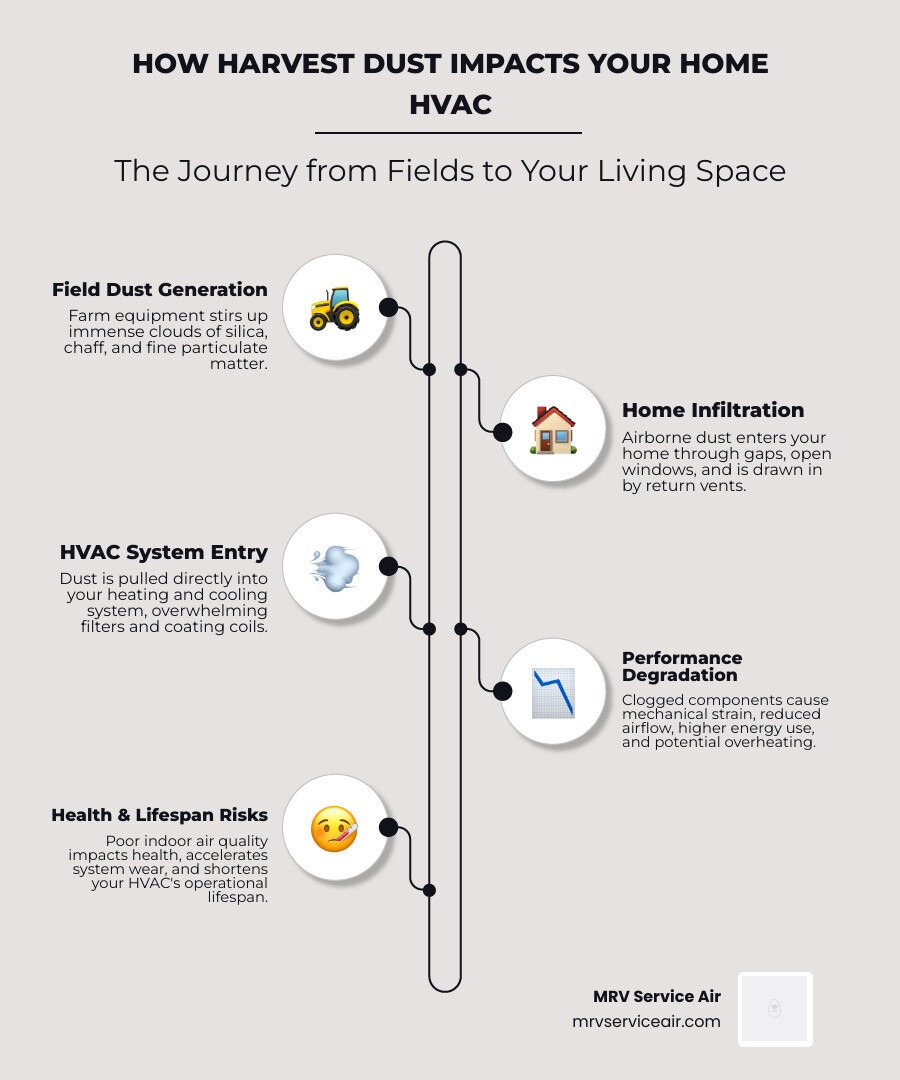
The Dirty Truth: How Harvest Season Dust Affects Your HVAC System
In Des Moines, we live in one of the most productive agricultural regions in the world. But that productivity comes with a side effect: a massive increase in airborne particulate matter during the harvest months. Understanding how harvest season dust affects your HVAC system starts with knowing exactly what is in that “dust.”
Unlike the soft, grey lint you find under your sofa, agricultural dust is a complex and aggressive mixture. It contains:
- Silica and Soil Minerals: These are essentially tiny rocks. They are abrasive and can physically grind down moving parts in your HVAC system.
- Chaff and Organic Debris: Dried plant matter from corn and soybeans. This material is highly flammable and provides a food source for biological growth if it gets damp inside your ducts.
- Pesticide and Fertilizer Residue: Chemicals used in the fields can latch onto dust particles and enter your home, where they are recirculated by your air conditioner.
- Mold Spores and Pollen: Harvest stirs up settled allergens, sending them skyward and eventually into your intake vents.
When this mixture enters your home, it doesn’t just sit there. Because your HVAC system is designed to move air, it acts like a giant vacuum, pulling these contaminants deep into its internal components. This is why we emphasize More info about indoor air quality services in Des Moines for our neighbors in Central Iowa; standard cleaning just isn’t enough when the air outside is thick with field debris.
Mechanical Strain: How Harvest Season Dust Affects Your HVAC System Components
The internal components of your HVAC system are precision-engineered to work with clean air. When agricultural dust enters the mix, it acts like sand in the gears of a watch.
The Blower Motor The blower motor is the heart of your system, responsible for pushing air through your vents. As dust accumulates on the fan blades, it creates an “imbalance.” This makes the motor vibrate, leading to premature bearing failure. Furthermore, dust acts as an insulator. When the motor is coated in a layer of fine silt, it can’t dissipate heat properly, leading to overheating and total motor burnout.
Evaporator and Condenser Coils Your system relies on these coils to swap heat. In the summer, the evaporator coil gets cold to pull heat out of your indoor air. If that coil is covered in harvest dust, the dust acts as a barrier. Your AC has to run longer to achieve the same cooling effect. This is a primary reason why we suggest a professional AC service Des Moines during the peak of the dusty season.
Long-term risks: how harvest season dust affects your HVAC system lifespan
We often tell our customers that a well-cared-for HVAC system should last about 15 years. However, in rural environments like ours, that number can drop significantly if dust isn’t managed.
The constant friction caused by silica particles leads to “pitting” on metal surfaces and degrades the seals on your compressor. Think of it like a car engine: if you never changed the air filter while driving through a sandstorm, the engine wouldn’t last very long. The same logic applies to your home’s comfort system. By working with a qualified HVAC contractor services team, you can ensure that these microscopic “sandblasters” are removed before they cause permanent damage.
Signs Your Des Moines Home is Infiltrated by Agricultural Dust
It is now April 2026, and as we look toward the upcoming heat and harvest cycles, it is vital to recognize the early warning signs that your system is struggling. You don’t always need a technician to tell you there’s a problem; your home will give you plenty of clues.
- Reduced Airflow: If you notice that the air coming out of your vents feels “weak,” it’s likely that a thick layer of dust has clogged your filter or your evaporator coil.
- Unusual Noises: Whistling, rattling, or grinding sounds often indicate that dust has interfered with the blower motor or that a filter has been sucked out of place due to high pressure.
- The “Dusty” Smell: When you first turn on your heater or AC, do you smell something like burnt dirt? That’s the smell of agricultural debris being heated up or damp dust in the ducts.
- Short Cycling: If your system turns on and off every few minutes, it might be overheating because it can’t “breathe” through the dust.
For those using Heating systems in Ankeny and Des Moines, these signs often appear right as the harvest begins to peak.
Efficiency Loss: How Harvest Season Dust Affects Your HVAC System Performance
When your system is fighting against dust, efficiency loss is the most immediate way how harvest season dust affects your HVAC system.
When airflow is restricted by a dirty filter or a clogged coil, the system has to run for longer cycles to reach the temperature set on your thermostat. In the Central Iowa heat, this can lead to higher energy usage. Furthermore, dust buildup can throw off your home’s humidity balance. Dust particles actually hold onto moisture, which can make your home feel “stuffy” or “muggy” even when the AC is running. Our Central HVAC services in Des Moines are designed to calibrate these systems back to their peak performance, ensuring you aren’t paying for “lost” energy.
How to Protect Your Indoor Air Quality During Harvest
You can’t stop the harvest, and you certainly can’t stop the wind from blowing, but you can turn your home into a fortress against agricultural dust.
Seal the Enclosure Dust enters through more than just the front door. It sneaks in through tiny cracks around windows and doors. We recommend checking your weatherstripping every spring. If you can see light through a door crack, harvest dust can get in.
Address the Ductwork One of the biggest “entry points” for dust is actually your ductwork. If your ducts are located in a crawlspace or attic, they may have small leaks. Because of the pressure differences, these leaks can “suck in” dusty, unconditioned air and blow it directly into your bedrooms. This is why professional Duct work Des Moines and Ventilation work Des Moines are so critical for rural homes.
Upgrading your filtration and purification
If you are still using the standard 1-inch “fiberglass” filters, you are only protecting your equipment from large hairballs—you aren’t protecting your family’s lungs from harvest dust.
- MERV Ratings: We recommend a MERV 11 or MERV 13 filter during harvest season. These are dense enough to catch fine silica and chaff without putting too much strain on your blower motor.
- HEPA Filters: For families with severe allergies or asthma, a HEPA (High-Efficiency Particulate Air) system can trap 99.97% of particles.
- Ductless Options: Sometimes, the best way to avoid duct-related dust issues is to bypass them entirely. Ductless HVAC options in Des Moines are excellent for room-specific cooling without the risk of attic dust infiltration.
Implementing these Indoor air quality solutions in Des Moines is the best way to ensure that the “dirty truth” about harvest season stays outside where it belongs.
The Role of Professional Maintenance in Combating Dust
While homeowners can (and should) change their own filters, there are parts of the system that simply require a professional touch. Agricultural dust is sticky; it binds with the condensation on your coils to create a “mud” that a vacuum can’t remove.
| Feature | Standard 1-Inch Filter | High-Performance Purifier |
|---|---|---|
| Dust Capture | Large particles only (lint/hair) | Microscopic particles (silica/chaff) |
| Airflow Impact | Low | Managed via system calibration |
| Allergen Removal | Minimal | Up to 99.9% |
| Maintenance | Change every 30 days | Annual professional service |
Professional maintenance involves more than just a quick look. It includes “deep vacuuming” of the cabinet, chemical cleaning of the coils, and checking the “static pressure” of the system to ensure the dust hasn’t caused a bottleneck. These Energy efficiency services in Des Moines help maintain peak performance.
Seasonal tune-ups for rural environments
As of April 2026, the standards for HVAC efficiency have never been higher. A seasonal tune-up is your best defense against the upcoming harvest. We don’t just “check” the system; we calibrate it. We ensure the refrigerant levels are perfect (since dust-clogged coils can mimic low refrigerant symptoms) and that the electrical connections are tight.
For those with gas-fired units, our Furnace services Des Moines ensure that the burner assembly is free of dust, which prevents “delayed ignition” and keeps your home safe from carbon monoxide risks associated with dirty combustion.
Frequently Asked Questions about Harvest Dust
How often should I change my filter during harvest season?
In Des Moines, during the peak of the corn or soybean harvest, you should check your filter every 2 weeks. You will likely need to replace it every 30 days, whereas, in the “cleaner” months, you might get away with 60 or 90 days. If the filter looks grey or “fuzzy,” it’s time for a change.
Can agricultural dust cause permanent damage to my AC?
Yes. Silica dust is abrasive. If it gets into the bearings of your blower motor or the internal valves of your compressor, it can cause physical wear that cannot be “cleaned” away. In these cases, the only solution is component replacement.
Why does my house feel more humid when it is dusty outside?
Dust buildup on your evaporator coil prevents it from effectively removing moisture from the air. When the coil is “insulated” by a layer of agricultural mud, it can’t get cold enough to condense water vapor, leaving your indoor air feeling sticky and humid.
Conclusion
At All Seasons HVAC LLC, we are proud to be a part of the Des Moines community. We understand the unique challenges that come with living in the heart of Central Iowa, and we know exactly how harvest season dust affects your HVAC system. Our goal is to provide you with prompt, quality service so you can breathe easy regardless of what is happening in the fields.
Don’t wait for your system to overheat or your utility bills to rise. Protect your home, your health, and your investment by staying ahead of the harvest haze.
Schedule your harvest season HVAC maintenance today and let us help you keep the “dirty truth” out of your indoor air.