








Should I Repair or Replace My HVAC System? Here’s How to Decide Fast
Should I repair or replace my HVAC system is one of the most common — and most stressful — questions homeowners face, especially when a breakdown hits during a Kern County heat wave or a cold winter night. The wrong call can cost you thousands of dollars, either in piling-up repair bills or in a premature replacement you didn’t actually need yet.
The good news: there’s a clear framework to help you decide quickly and confidently.
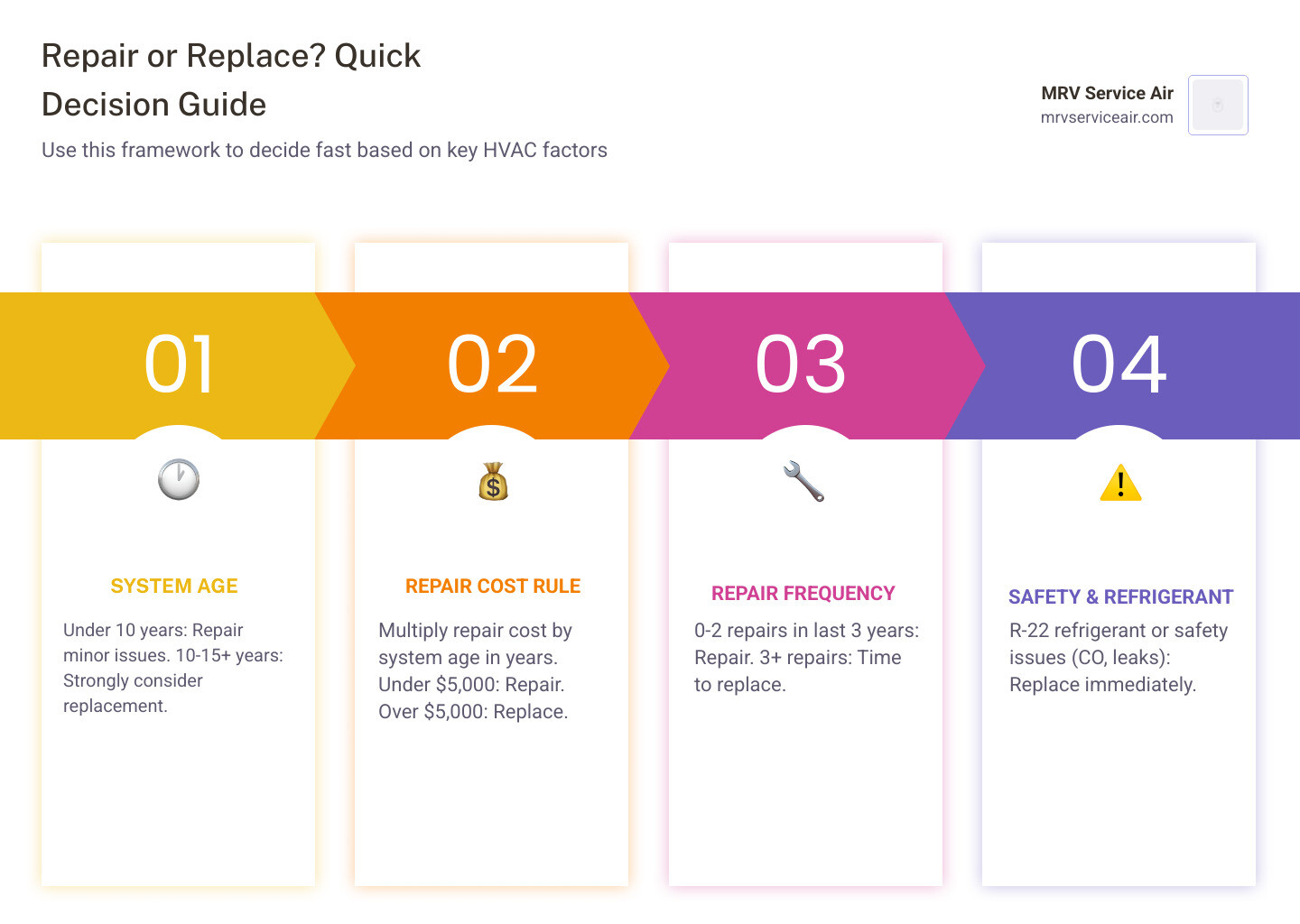
Quick Answer: Repair or Replace?
| Situation | Likely Decision |
|---|---|
| System is under 10 years old, minor issue | Repair |
| Repair cost x system age is under $5,000 | Repair |
| 0–2 repairs in the last 3 years | Repair |
| System is 10–15+ years old | Consider replacing |
| Repair cost x system age exceeds $5,000 | Replace |
| 3 or more repairs in the last 3 years | Replace |
| System uses R-22 refrigerant | Replace |
| Safety issue (carbon monoxide, gas leak) | Replace immediately |
Most homeowners fall into one of two camps: fixing the same aging system over and over hoping it holds on, or jumping to a full replacement before it’s truly necessary. Neither extreme serves you well. What actually helps is knowing which specific factors matter — system age, repair history, efficiency ratings, and total repair cost — and how to weigh them together.
In this guide, we’ll walk you through every factor that should go into your decision, so you can stop guessing and start acting with confidence.
Evaluating System Age and Performance Thresholds

The first thing we look at when helping a neighbor in Delano decide the fate of their unit is the manufacturing date. Just like a car, every HVAC component has a “best before” date where the cost of keeping it running begins to outweigh the benefits of a new, shiny model.
In the industry, we generally see the following lifespans:
- Heat Pumps: Approximately 15 years.
- Furnaces: Typically 15 to 20 years.
- Central Air Conditioners: Usually 15 to 20 years.
Energy.gov and ENERGY STAR® provide even more conservative benchmarks for when you should start shopping. They suggest considering replacement for air conditioners and heat pumps once they cross the 10-year mark, and for furnaces once they hit 15 years. While a well-maintained system can certainly last longer, the efficiency drop-off after a decade is often significant. If your unit is approaching these milestones, even a “small” repair might be the first of many. For more specialized insights, you can find more info about heating systems in Bakersfield.
Maintenance history and reliability
How often have we seen you lately? If we’re on a first-name basis because your system breaks down every season, that’s a major red flag. A common industry standard is the “3-year rule”: if you have needed three or more significant repairs in the last three years, your system is likely at the end of its functional life.
Component wear is cumulative. When a major part like a compressor or heat exchanger begins to fail, it often puts additional strain on the rest of the system. Continually patching up an old unit is often referred to as “throwing good money after bad.” If you’re unsure about your system’s track record, a professional assessment can help. Check out more info about HVAC contractor services to see how a pro evaluates reliability.
Performance consistency
Age isn’t just about years; it’s about how the system feels. Is your living room an ice box while the master bedroom feels like a sauna? Uneven temperatures, weak airflow, and skyrocketing humidity levels are signs that your system can no longer keep up with the demands of your home.
Often, these issues can be linked to aging blowers or failing ductwork. In some cases, the equipment itself is simply “tired” and can no longer reach the necessary pressures or temperatures to maintain comfort. If you are noticing more dust than usual or struggling with indoor humidity, it might be time to look at more info about ventilation work to see if your system is still capable of providing a healthy home environment.
The Financial Framework: should i repair or replace my hvac system?
Deciding should i repair or replace my hvac system often comes down to the bottom line. While a repair is almost always cheaper in the short term, the long-term return on investment (ROI) of a new system is often much higher.
We encourage homeowners to look at the “repair-to-replacement ratio.” If a single repair costs more than 50% of what a brand-new, high-efficiency system would cost, the choice is clear: replace it. Additionally, check your warranty status. If your unit is still under a manufacturer’s parts warranty, a repair is almost always the smarter move. However, most warranties expire after 5 or 10 years, leaving you responsible for both parts and labor. To understand how modern systems are integrated, see more info about central HVAC services.
Using the $5,000 rule: should i repair or replace my hvac system?
One of the most reliable tools in our industry is the “$5,000 Rule.” It’s a simple math formula that takes the emotion out of the decision.
The Formula: (Age of the System in Years) x (Cost of the Repair) = ?
- If the total is less than $5,000: It usually makes sense to repair the unit.
- If the total is more than $5,000: It is generally smarter to replace the unit.
For example, if you have a 12-year-old AC unit that needs a $600 repair, your total is $7,200. According to the rule, you should replace it. Conversely, if a 5-year-old furnace needs a $400 fix, the total is $2,000, making a repair the clear winner. This helps you see the investment value of your home equipment. For help visualizing how a new system would fit into your home, you can find more info about HVAC planning and design.
Efficiency ratings: should i repair or replace my hvac system?
Efficiency isn’t just a buzzword; it’s a direct reflection of your monthly energy consumption. If you are asking should i repair or replace my hvac system, you must look at your current unit’s ratings:
- SEER2 (Seasonal Energy Efficiency Ratio): Measures cooling efficiency. Older units often have a SEER of 8 or 10. Modern standards in the South/Southwest now require at least a SEER of 15. Switching from a SEER 9 to a SEER 14 unit can reduce your cooling energy consumption by more than 35%.
- HSPF2 (Heating Seasonal Performance Factor): Measures heat pump heating efficiency.
- AFUE (Annual Fuel Utilization Efficiency): Measures furnace efficiency. Older furnaces might be 80% AFUE (meaning 20% of the fuel is wasted), while new ENERGY STAR models can reach 95% or higher.
The savings on your monthly utility bills can often “pay back” the cost of a new system over several years. You can learn more about these savings by looking at more info about energy efficiency services.
Key Indicators for a Full System Upgrade
Sometimes, the decision is made for you by external factors. Rising energy bills that don’t match your usage patterns are a classic sign that your system is working harder than ever to achieve less. Frequent breakdowns during peak summer or winter months also indicate that the system’s mechanical integrity is compromised.
One of the biggest “deal-breakers” for older air conditioners is the R-22 refrigerant phase-out. If your system was built before 2010, it likely uses R-22 (Freon). This refrigerant is no longer produced because it damages the ozone layer. Because the supply is so limited, the cost to “recharge” a system with a leak is now astronomical. In most cases, if an R-22 system has a major leak or compressor failure, replacement is the only logical path. For local assistance with these upgrades, see more info about AC service in Bakersfield.
Modern comfort features
A new system does more than just blow cold or hot air; it transforms the “feel” of your home. Modern upgrades offer features that older units simply can’t match:
- Variable-Speed Technology: Instead of being “all on” or “all off,” these motors adjust their speed to maintain a precise temperature, leading to quieter operation and better humidity control.
- Smart Home Integration: Control your comfort from your phone and receive alerts if the system detects an issue.
- Zoning Capabilities: Heat or cool specific rooms independently, saving energy and ending arguments over the thermostat.
If your current system leaves you feeling “stuffy” or uncomfortable, even when it’s technically running, these features might be worth the upgrade. Explore more info about ductless HVAC solutions for more flexible comfort options.
Homeownership timeline
Are you planning to stay in your Delano home for the next 20 years, or are you putting a “For Sale” sign in the yard next spring?
- Planning to Sell: A repair might be enough to get the system through a home inspection. However, a brand-new HVAC system is a major selling point that can increase property value and speed up a sale.
- Staying Put: If this is your “forever home,” investing in a high-efficiency system now ensures you enjoy the comfort and lower bills for years to come.
Your long-term residency plans should heavily weigh into your choice. Improved comfort and air quality are investments in your quality of life. For more on how these systems affect your home’s air, see more info about indoor air quality.
Safety Risks and Environmental Compliance
Safety is the one area where we never compromise. There are certain “red alert” situations where we will always recommend an immediate replacement:
- Cracked Heat Exchanger: In a furnace, this can allow deadly carbon monoxide (CO) to leak into your home’s air. This is a critical fire and health hazard.
- Persistent Electrical Issues: Frayed wiring or failing components that frequently trip breakers can pose a fire risk.
- Gas Leaks: Any compromise in the fuel delivery system that cannot be easily and permanently fixed.
If your system is red-tagged for safety, don’t wait. For reliable furnace assessments, you can find more info about furnace services.
Refrigerant regulations and the environment
As we mentioned with the R-22 phase-out, the industry is moving toward more eco-friendly refrigerants like R-410A and newer alternatives. Newer systems are designed to be much more tightly sealed and use chemicals that have a much lower impact on the environment. Replacing an old, leaky unit isn’t just good for your wallet; it’s a responsible choice for the planet. If you’re considering an eco-friendly switch, check out more info about heat pump services.
Financial incentives in 2026
As of April 2026, there are more ways than ever to offset the cost of a new system. Homeowners can take advantage of significant federal tax credits—sometimes up to 30% of the project cost for high-efficiency heat pumps. Additionally, local utility companies often provide rebates for switching to ENERGY STAR® certified equipment.
Combining these incentives with manufacturer specials can bring the total investment down significantly, making a replacement much more attractive than a costly repair on an old unit. You can view our current offers by visiting more info about specials and rebates.
Frequently Asked Questions
What is the $5,000 rule for HVAC?
The $5,000 rule is a financial guideline used to decide between repairing or replacing your system. Multiply the age of your unit by the estimated repair cost. If the result is over $5,000, it is generally considered more cost-effective to replace the system rather than repair it.
When is the best time of year to replace my system?
The best time to replace your HVAC system is during the “shoulder seasons”—typically the spring (March to May) and the fall (September to November). During these times, demand is lower, meaning you can often find better deals and have more flexibility in scheduling your installation.
How much can a new high-efficiency unit save on monthly bills?
Switching from an older, standard-efficiency unit to a modern ENERGY STAR® certified system can save you between 20% and 40% on your monthly heating and cooling costs. Over the lifespan of the unit, these savings can often cover a significant portion of the initial purchase price.
Conclusion
Deciding whether to repair or replace your HVAC system doesn’t have to be a headache. By using the $5,000 rule, considering the age of your equipment, and evaluating your long-term comfort needs, you can make a choice that fits both your home and your budget.
At MRV Service Air, we are dedicated to providing the residents of Delano with prompt, quality service at affordable prices. Whether you need a quick fix to get through the week or a professional assessment for a full system upgrade, our team is here to help you stay cool.
Don’t wait for a total system failure to start exploring your options. Schedule your HVAC evaluation with MRV Service Air today and let us help you find the perfect comfort solution for your home.