







When to Repair vs Replace Your HVAC System: What Every Homeowner Needs to Know
Knowing when to repair vs replace your HVAC system can save you from throwing money at a unit that’s already past its prime — or spending unnecessarily on a full replacement when a simple fix would do. Most HVAC systems last between 10 and 15 years, though well-maintained units can push 20. When something goes wrong, the decision you make in the next few hours can either protect your budget or quietly drain it for years to come.
Here’s a quick-reference guide to help you decide:
Repair your HVAC system if:
- The system is under 10 years old
- The repair is minor and isolated (e.g., capacitor, fan motor, thermostat)
- The repair cost is less than 30–50% of a new system’s cost
- You’ve had fewer than 3 repairs in the last 3 years
- The system still heats and cools your home evenly and efficiently
Replace your HVAC system if:
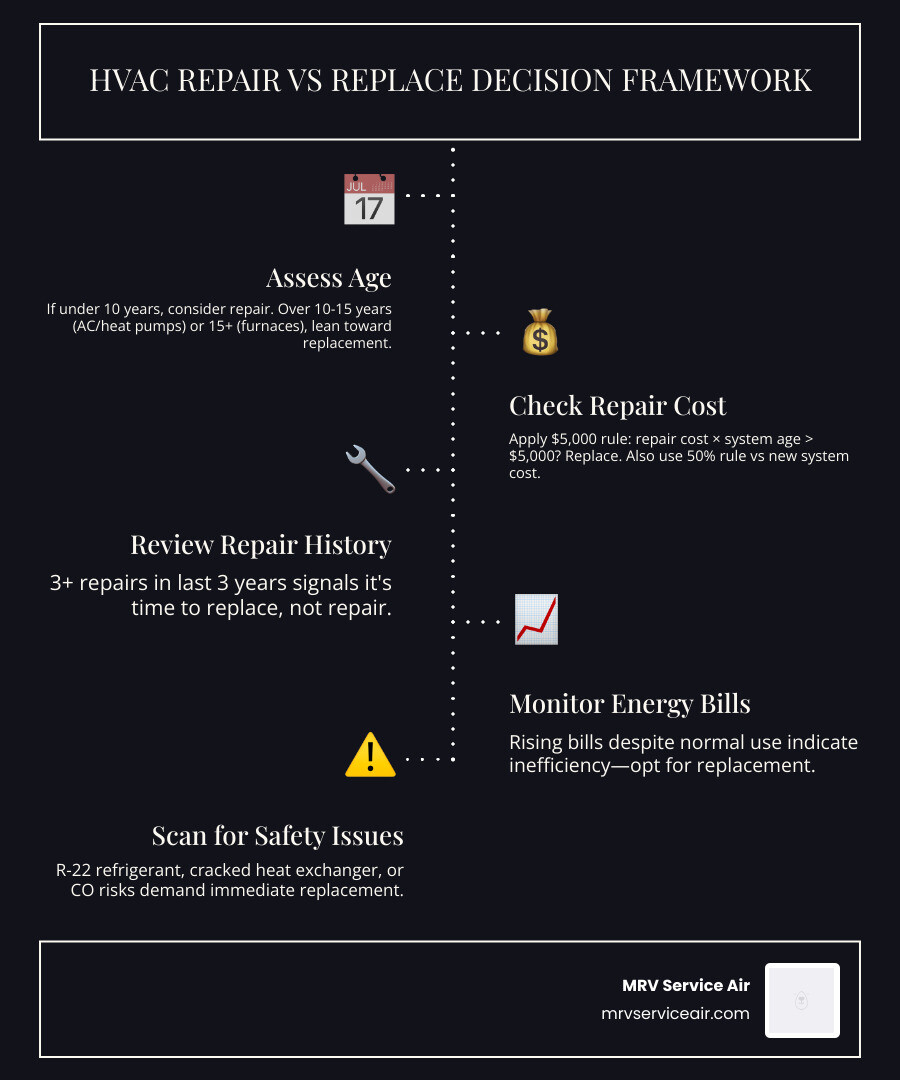
- The system is 10–15+ years old (10+ for AC/heat pumps, 15+ for furnaces)
- The repair cost multiplied by the system’s age exceeds $5,000 (the industry “$5,000 rule”)
- You’ve made 3 or more repairs in the last 3 years
- Your energy bills keep climbing despite normal usage
- The system uses R-22 refrigerant, which is now phased out and expensive
- There are safety concerns like a cracked heat exchanger or carbon monoxide risk
For most homeowners in the Des Moines area, the decision hits hardest during a summer heatwave or a cold January night — exactly when you have the least time to think it through carefully. That’s why it helps to understand the full picture before an emergency forces your hand.
The sections below walk you through every factor that matters: warning signs, financial rules of thumb, safety triggers, efficiency upgrades, and available rebates — so you can make a confident, informed choice for your home.
Recognizing the Warning Signs in Your Home

It starts with a subtle noise or a room that just won’t stay cool. Before you can decide when to repair vs replace your hvac system, you have to recognize when the system is waving a white flag. Many homeowners ignore small signs until they turn into major failures, but your system is usually quite talkative about its condition.
Common indicators that your system needs professional attention include:
- Strange Noises: Rattling, squealing, or grinding sounds often point to loose parts, failing motors, or a compressor on its last legs.
- Rising Energy Bills: If your utility costs are climbing in April 2026 compared to April 2025, but your usage habits haven’t changed, your system is likely losing its efficiency.
- Uneven Temperatures: If the living room feels like the Arctic while the bedroom feels like a sauna, your system may no longer be powerful enough to circulate air properly.
- Frequent Repairs: If you feel like your HVAC technician is on your speed dial, you’re likely in a “repair spiral” where one fix leads to another.
For those experiencing these issues, we offer comprehensive AC services and expert care for heating systems to help diagnose the root cause.
Common Red Flags for Homeowners
Beyond the obvious breakdowns, there are several “stealth” signs that your HVAC is struggling:
- Humidity Problems: A healthy AC should naturally dehumidify your home. If the air feels “sticky” or heavy, the system isn’t doing its job.
- Excessive Dust: Older systems often struggle to filter air, leading to more dust on your furniture and in your lungs.
- Short-Cycling: If your unit turns on and off every few minutes, it’s working overtime and burning through components.
- Poor Air Quality: Lingering odors or increased allergy symptoms can signal mold in the coils or failing filtration.
Improving your indoor air quality is often a primary motivator for homeowners to move toward a replacement rather than sticking with an outdated, dusty unit.
The Financial Math: When to Repair vs Replace Your HVAC System
When the quote for a repair lands on your kitchen table, it’s time to pull out the calculator. We recommend using two industry-standard rules to take the emotion out of the decision.
- The $5,000 Rule: Multiply the age of your system by the repair estimate. If the total is more than $5,000, it’s time to replace it. For example, a 12-year-old AC needing a $500 repair equals $6,000—a clear signal to replace. A 5-year-old unit with the same $500 repair equals $2,500—definitely worth repairing.
- The 50% Rule: If the cost of a single repair is more than 50% of the cost of a brand-new system, a replacement is almost always the smarter long-term investment.
| Factor | Favor Repair | Favor Replace |
|---|---|---|
| System Age | Under 10 years | Over 15 years |
| Repair Cost | Under 30% of new unit | Over 50% of new unit |
| Repair History | 0-1 in last 3 years | 3+ in last 3 years |
| Energy Bills | Stable | Consistently rising |
| Comfort | Even temperatures | Hot/cold spots |
If you’re facing a major issue with your heater, our furnace services can provide the specific data you need to apply these rules accurately.
How System Age Impacts When to Repair vs Replace Your HVAC System
Age is more than just a number; it’s a risk profile. Heat pumps and air conditioners typically have a lifespan of 10 to 15 years. Furnaces and boilers can last closer to 15 or 20 years with perfect maintenance.
Once a system crosses the 10-year mark, its efficiency begins to drop significantly compared to modern standards. ENERGY STAR recommends considering a replacement for any AC or heat pump over 10 years old to take advantage of units that are up to 20% more efficient. Investing in energy efficiency now can pay for itself through lower monthly bills over the next decade.
Professional Insights on When to Repair vs Replace Your HVAC System
A professional evaluation looks at things the average homeowner can’t see. We check the integrity of your duct work to ensure a new unit won’t be hampered by leaks. We also look at system sizing. Many older homes have units that were never sized correctly for the square footage, leading to premature wear.
During the planning and design phase of a replacement, we ensure your new system is perfectly matched to your home’s layout and insulation levels, preventing the “short-cycling” issues that plague older, oversized units.
Critical Safety and Environmental Triggers for Replacement
Sometimes, the decision isn’t about money—it’s about safety. There are certain “red line” issues where we will always recommend replacement because the risk to your family is too high.
- Cracked Heat Exchanger: This is the most dangerous furnace failure. A crack allows carbon monoxide—a silent, odorless killer—to leak directly into your home’s airstream. These cannot be reliably “patched.”
- Gas Leaks: Repeated issues with gas valves or connections are fire hazards that shouldn’t be ignored.
- Electrical Fire Hazards: Frayed wiring or scorched control boards in an aging unit are major red flags.
Beyond safety, environmental regulations play a role. If your system was installed before 2010, it likely uses R-22 refrigerant (Freon). The EPA has phased out the production and import of R-22 because of its ozone-depleting properties. As of 2026, the supply is extremely limited, making a simple refrigerant recharge prohibitively expensive. This is often the final nudge homeowners need to upgrade their central HVAC services.
Navigating the R-22 Phase-Out and Safety Risks
Repairing an R-22 system is often a case of “throwing good money after bad.” A single leak repair and recharge can cost a significant fraction of a new, eco-friendly system. Modern units use R-410A or the even newer R-454B, which are better for the planet and much more affordable to service.
Proper ventilation work is also critical. If your old system was venting poorly, it could be backing up combustion gases into your home. A replacement allows for the installation of modern, high-efficiency venting that keeps your indoor air safe.
The Long-Term Benefits of Modern System Upgrades
If you decide to replace, you aren’t just getting a “working” version of what you had before. HVAC technology has leaped forward in the last decade.
- SEER2 Ratings: Modern air conditioners are rated by SEER2 (Seasonal Energy Efficiency Ratio). While your old unit might be a SEER 8 or 10, new standard models start at 14.3, and premium models can exceed 20. Switching from SEER 9 to SEER 14 can reduce energy consumption by over 35%.
- Variable-Speed Technology: Older units are either “on” or “off.” Modern variable-speed compressors can run at lower speeds to maintain a perfect, steady temperature, which is much quieter and more efficient.
- Smart Integration: New systems play well with smart thermostats, allowing you to control your home’s climate from your phone.
Whether you are looking at heat pump services for year-round efficiency or a mini-split HVAC for a specific room or addition, the comfort levels of modern equipment are night-and-day compared to 15-year-old technology.
Financial Incentives for Modern Upgrades
The upfront cost of a new system is often the biggest hurdle, but 2026 is a great year for incentives. Between the Inflation Reduction Act and local utility promotions, you can often offset a significant portion of the cost.
- Tax Credits: You may be eligible for federal tax credits (up to $2,000 for heat pumps) for installing high-efficiency equipment.
- Utility Rebates: Many local energy providers offer cash-back rebates for switching to ENERGY STAR-certified units.
- HEEHRA Rebates: Depending on household income, some families can access substantial point-of-sale rebates for electrification.
Check our specials and rebates page for current offers. Many homeowners find that a ductless HVAC system is a particularly cost-effective way to upgrade without the mess of major ductwork renovations.
Frequently Asked Questions about HVAC Decisions
What is the $5,000 rule for HVAC?
The $5,000 rule is a simple mathematical formula: System Age x Repair Cost. If the result is greater than $5,000, replacement is generally recommended. For example, a 10-year-old system needing a $600 repair ($6,000 total) is a candidate for replacement.
Is it worth repairing a system that uses R-22 refrigerant?
In almost all cases, no. R-22 is no longer produced, making it extremely expensive to source. Furthermore, if an R-22 system has a leak, it’s likely an older unit nearing the end of its lifespan. Investing that money into a modern system is a better long-term financial move.
How much can I save by switching to an ENERGY STAR system?
According to ENERGY STAR, replacing a 10-year-old AC or heat pump with a certified model can save you up to 20% on your annual heating and cooling costs. High-efficiency furnaces can be up to 15% more efficient than standard models, leading to hundreds of dollars in savings over the life of the unit.
Conclusion
Deciding when to repair vs replace your HVAC system doesn’t have to be a high-stakes guessing game. By looking at the age of your unit, the frequency of your repairs, and the potential for energy savings, the right path usually becomes clear. At MRV Service Air, we are committed to providing the residents of Des Moines and the surrounding communities with prompt, quality service at affordable prices.
We believe in honest evaluations. If a simple repair will give your system another three years of reliable life, we’ll tell you. If your system is a safety risk or a “money pit,” we’ll show you why and help you find a replacement that fits your budget through our flexible financing options. Don’t wait for a total breakdown in the middle of an Iowa summer.
Contact our expert team for a professional HVAC evaluation in Des Moines today and let us help you stay comfortable all year long.