







Understanding the Mini Split vs Central AC Cost Comparison
#
The mini split vs central ac cost comparison comes down to one key question: does your home already have ductwork?
Quick Answer:
| Situation | Cheaper Option |
|---|---|
| Home has existing, well-sealed ducts | Central AC |
| Home has no ductwork | Mini split |
| Single room, addition, or garage | Mini split (single-zone) |
| Whole home, 2,000+ sq ft, good ducts | Central AC |
| Older home, historic, or hard to retrofit | Mini split |
- Mini splits cost less upfront for ductless homes and use 20-30% less energy overall
- Central AC is usually the smarter buy when quality ductwork is already in place
- Both systems last 15-20 years with proper maintenance
- Mini splits also provide heating, which can replace a separate furnace entirely
If you’re trying to figure out which system saves more money for your home, you’re not alone. It’s one of the most common questions homeowners face when their HVAC system needs replacing or they’re cooling a new space.
The honest answer isn’t simple. A contractor quoting you central air isn’t wrong. Neither is the one recommending a mini split. The right choice depends on your home’s structure, your existing setup, and how you use your space day to day.
One real-world example sums it up well: a homeowner with a 1920s stone farmhouse had no ductwork at all. Installing central air would have meant tearing into original walls and spending significantly more. A three-zone mini split handled the whole house for roughly half the cost, and the walls stayed intact.
That’s the kind of detail this guide will walk you through, so you can make a confident, informed decision for your home.
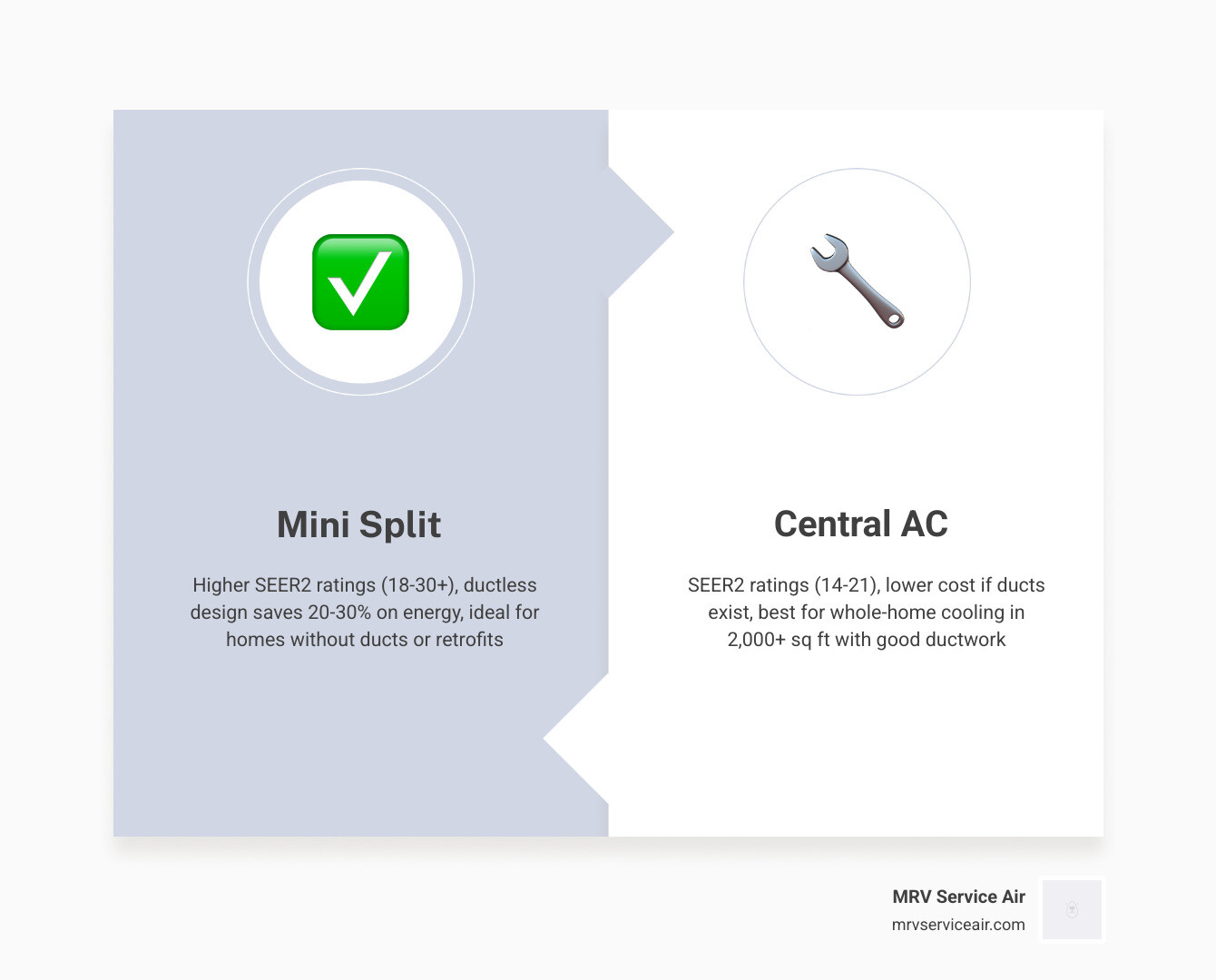
When we look at the mini split vs central ac cost comparison in 2026, we have to look past the sticker price and focus on technology. Two of the biggest factors in how much you’ll spend over time are SEER2 ratings and inverter technology.
SEER2 (Seasonal Energy Efficiency Ratio 2) measures how much cooling a system provides for every watt of electricity it uses. In April 2026, the standards have moved toward higher efficiency. Central AC systems typically reach SEER2 ratings between 14 and 21. In contrast, ductless mini splits are often much higher, with many models reaching between 18 and 30+.
The secret behind the mini split’s high efficiency is the inverter-driven variable-speed compressor. Unlike a traditional central AC that turns on and off like a light switch, an inverter compressor ramps up and down like a dimmer switch. It runs at the lowest speed necessary to maintain your comfort, which prevents the energy spikes associated with frequent starting and stopping.
Furthermore, mini splits offer built-in zoning. You only cool the rooms you are actually using. For more details on how these systems fit into your home, you can find more info about ductless HVAC services to see how they differ from traditional setups.
| Feature | Central AC | Ductless Mini Split |
|---|---|---|
| Typical SEER2 | 14 – 21 | 18 – 30+ |
| Compressor Type | Single/Two-Stage | Variable-Speed Inverter |
| Zoning | Difficult/Expensive | Native (Standard) |
| Energy Loss | 20–30% (Duct leaks) | 0% (Ductless) |
How Home Size Affects Your Mini Split vs Central AC Cost Comparison
Your home’s square footage is the primary driver of the equipment size you need, measured in BTUs (British Thermal Units). For a large, open-concept home of 2,500 square feet or more, central AC is often the most practical choice if you want uniform cooling throughout every hallway and bathroom.
However, as the home size increases, so does the complexity of a mini split system. To cool a whole house, we would need to install a multi-zone system with several indoor air handlers connected to one or more outdoor condensers. While this offers incredible control, the equipment costs for a 5-zone mini split can sometimes exceed the cost of a high-efficiency central unit.
If you have a large home with existing ductwork that is in good repair, sticking with a central system is usually the most cost-effective path. You can explore more info about central HVAC services to understand how we size these systems for Central Iowa homes.
Evaluating the Mini Split vs Central AC Cost Comparison for Older Homes
In areas like Des Moines or Indianola, we often work in beautiful historic homes that were built long before air conditioning was a standard feature. These homes often have plaster walls, intricate woodwork, and no room for bulky ductwork.
Retrofitting central AC into these structures can be a nightmare. It often involves “dropping” ceilings or building “soffits” to hide ducts, which ruins the historic aesthetic and structural integrity of the home. In these cases, the mini split vs central ac cost comparison swings heavily in favor of ductless.
A mini split only requires a small three-inch hole in the wall for the refrigerant lines. This preserves the home’s charm while providing modern comfort. When we assist with more info about planning and design, we look at how to integrate these units so they provide maximum comfort with minimum visual impact.
Installation Variables and Structural Requirements
The physical installation process is where the “hidden” costs of HVAC live. If your home already has a furnace and ducts, replacing a central AC unit is a straightforward job that can often be completed in a single day.
However, if those ducts are old, leaky, or undersized, they might need to be replaced or sealed to handle a modern high-efficiency unit. According to the Department of Energy, typical duct systems lose 20% to 30% of conditioned air through leaks and poor insulation. If we have to install brand-new ductwork in an existing home, the labor and material costs can double or triple the total price of the project.
We offer more info about duct work services to help you determine if your current distribution system is up to the task or if it’s a “money pit” that should be bypassed in favor of a ductless system.
Impact of New Ductwork on Upfront Investment
Installing new ducts isn’t just about the metal tubes; it’s about where they go. If you have an accessible attic or a wide-open crawlspace, the job is easier. But if we have to cut through drywall or navigate tight floor joists, the labor complexity skyrockets.
Beyond the physical space, we also have to consider more info about indoor air quality. Central systems use a single, large filter. If the ducts are dirty or poorly sealed, they can pull in dust from the attic and distribute it throughout the house. Ductless systems, because they have no ducts, avoid this issue entirely, though they do require you to clean the small filters in each indoor unit more frequently.
For those considering a total home renovation, more info about ventilation work can provide a clearer picture of how air needs to move through your specific floor plan to remain fresh and healthy.
Single-Zone vs Multi-Zone Configuration
A “zone” is simply an area controlled by its own thermostat.
- Single-Zone: One outdoor unit connected to one indoor head. This is perfect for a garage, a sunroom, or a new master suite addition.
- Multi-Zone: One outdoor unit connected to two, three, four, or even eight indoor heads.
With more info about mini split HVAC, you can see how these configurations work. The outdoor condenser is placed on a pad outside, and “line sets” (copper tubing) carry the refrigerant to the indoor air handlers. These handlers can be mounted on the wall, tucked into the ceiling, or even hidden in the floor.
Energy Efficiency and Operational Savings in 2026
In 2026, energy prices are a major concern for everyone in Central Iowa. When comparing the mini split vs central ac cost comparison, the monthly utility bill is where the mini split usually wins.
Because there are no ducts, there is zero energy loss from air leaking into your attic or crawlspace. This alone can save you 20% on your cooling costs. Additionally, the ability to turn off the AC in the guest room or the basement when nobody is using them prevents you from paying to cool empty space.
Many modern mini splits are also heat pumps. This means they don’t just cool; they can provide highly efficient heat during the Iowa winters. You can learn more info about energy efficiency services and more info about heat pump services to see how a single system might replace both your old AC and your furnace.
Reducing Monthly Bills with Zoned Cooling
Think about your home’s occupancy patterns. Most families spend their days in the kitchen and living room and their nights in the bedrooms. With a central AC, you are cooling the bedrooms all day and the living room all night.
With a zoned mini split, you can set the living room to a comfortable temperature during the day while letting the bedrooms stay a bit warmer. This targeted comfort is the most effective way to reduce waste. If you are looking for more info about AC services, we can show you how to program these zones for maximum savings.
Incentives and Financial Benefits
To encourage energy efficiency, there are often significant federal tax credits and local utility rebates available in 2026. Under the Inflation Reduction Act, homeowners can often claim a tax credit of up to 30% of the project cost (capped at a certain amount per year) for high-efficiency heat pumps and mini splits.
Check out more info about specials and rebates to see what’s currently available for residents in Des Moines, Ankeny, and the surrounding areas. These incentives can often bridge the gap between a standard system and a premium, high-efficiency model, providing a much faster return on investment (ROI).
Long-Term Value and System Maintenance
Both central AC and mini splits are designed to last between 15 and 20 years, but that lifespan depends entirely on how well they are maintained.
Central AC maintenance involves checking the outdoor condenser, the indoor evaporator coil, and—most importantly—the ductwork. If ducts become disconnected or infested with pests, the system has to work harder, shortening its life. For professional support, more info about HVAC contractor services can help you set up a recurring plan.
Mini split maintenance is a bit more “hands-on” for the homeowner. Because the indoor units are smaller, their filters can clog quickly. We recommend cleaning the filters every two to four weeks if the system is used daily. Professional service is still required annually to check refrigerant levels and clean the blower wheels, which can sometimes develop mold if the drainage isn’t perfect.
Total Cost of Ownership Over 15 Years
When we look at the Total Cost of Ownership (TCO), we include the initial price, the energy bills, and the cost of repairs over 15 years.
- Central AC: Lower upfront cost (if ducts exist), but higher monthly bills and potential duct cleaning/repair costs.
- Mini Split: Higher upfront cost for whole-home setups, but significantly lower monthly bills and no duct maintenance.
In many Central Iowa homes, the energy savings from a mini split will “pay back” the higher initial investment within 5 to 7 years. After that, the system is essentially putting money back in your pocket every month. You can find more info about heating systems to see how the heating side of the math further improves the TCO.
Maintenance Requirements for Peak Performance
To keep your system running at peak performance, we focus on three things:
- Airflow: Keeping filters and coils clean so the system doesn’t “choke.”
- Refrigerant: Ensuring there are no leaks. A system low on refrigerant will run constantly and still not cool your home.
- Drainage: Making sure the condensation has a clear path out of the house.
If you have a furnace as part of your central system, more info about furnace services is vital to ensure your winter heating is as reliable as your summer cooling.
Frequently Asked Questions about HVAC Costs
Is a mini split more efficient than central air?
Yes, in almost every scenario. Mini splits avoid the 20-30% energy loss associated with ductwork. They also use inverter technology to match the cooling load exactly, rather than blasting on at 100% capacity and then shutting off.
Does central AC increase home value more than ductless?
Historically, central AC was seen as the “premium” option. However, in 2026, energy efficiency is a top priority for home buyers. A high-end, multi-zone mini split system is now seen as a major asset, especially in older homes or modern energy-efficient builds.
Can a mini split provide heating during the winter?
Absolutely. Most mini splits sold today are “heat pumps.” Modern cold-climate models can provide effective heat even when Iowa temperatures drop well below zero. This allows you to use the system year-round, increasing its value.
Conclusion
Choosing between these two systems isn’t just about the mini split vs central ac cost comparison—it’s about finding the right fit for your lifestyle and your home’s unique structure. At MRV Service Air, we pride ourselves on providing prompt, quality service at affordable prices to our neighbors in Delano and throughout Central Iowa.
Whether you are looking to cool a new addition in Ankeny or upgrade a historic home in Des Moines, we are here to help. We can perform a professional load calculation and a ductwork inspection to show you exactly which system will save you the most money over the long haul.
Ready to find the perfect cooling solution? You can find more info about AC installation and service or contact us today to schedule your customized HVAC assessment. We look forward to keeping you comfortable!