








Why Learning How to Extend the Life of Your AC Matters in the Central Valley
If you want to know how to extend the life of your AC, here is the short answer:
- Change your air filter every 1–3 months to prevent airflow restriction
- Schedule annual professional maintenance before summer hits
- Keep the outdoor condenser clear with at least 2 feet of space around it
- Set your thermostat to 78°F when home and higher when away
- Seal duct leaks and air gaps around doors and windows to reduce system workload
- Clean condenser coils regularly, especially in dusty Central Valley conditions
- Address warning signs early — strange noises, short cycling, or weak airflow
Your central air conditioner is one of the most hardworking appliances in your home — and in Delano, CA, that’s not an understatement. Summer temperatures in the Central Valley regularly push past 100°F, and the region’s fine dust and agricultural particulates put extra stress on every component inside your system. Most central AC units are built to last between 12 and 20 years, but research shows that routine servicing can push a unit’s lifespan from around 10 years to nearly 18. Neglect the basics, and that same unit may give out long before its time — leaving you with an emergency breakdown in the middle of a heat wave and a replacement bill you weren’t ready for.
The good news? Most of what shortens an AC unit’s life is completely preventable. The tips below are practical, proven, and designed specifically for homeowners dealing with the heat and dust of Kern County.
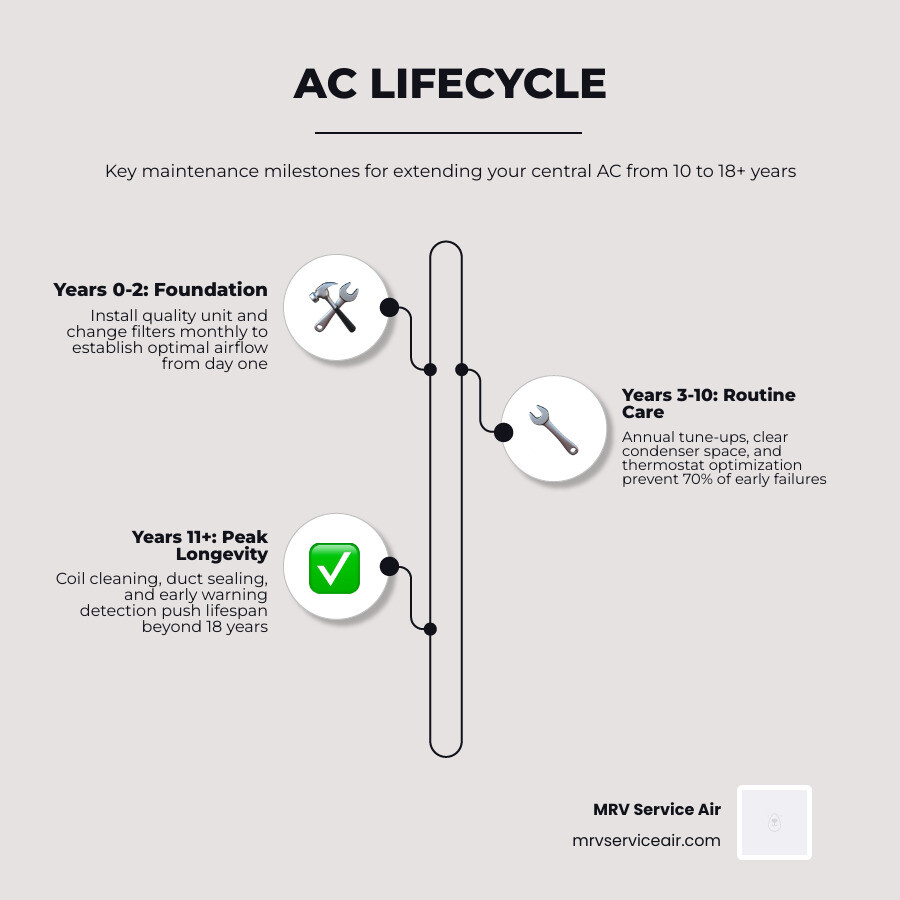
Master the Basics of How to Extend the Life of Your AC
When we talk about how to extend the life of your AC, we aren’t just talking about major repairs; we are talking about airflow. Think of your air conditioner like a pair of lungs. If it can’t “breathe” easily because of dust accumulation or blocked vents, it has to work twice as hard to move the same amount of cool air. In the Central Valley, where dust is a constant companion, maintaining this airflow is the single most important thing you can do for your system’s longevity.
Dust acts like an insulator in all the wrong places. It coats the indoor evaporator coil, preventing it from absorbing heat, and it clogs the outdoor condenser, preventing it from releasing that heat. This forced “overwork” leads to overheating and premature part failure. For more on managing these local challenges, check out our guide on Dusty Homes and Furry Friends: A Filter Change Schedule That Actually Works.
Prioritize Filter Changes to Extend the Life of Your AC
The “holy grail” of DIY maintenance is the air filter. It’s a simple, inexpensive part that protects a multi-thousand-dollar investment. In May 2026, with modern high-efficiency systems, the filter is even more critical. While standard filters should be changed every 90 days in some climates, Delano homeowners should perform monthly inspections.
If you have pets or live near agricultural fields in Tulare or Kern County, pet dander and fine silt will clog a filter in as little as 30 days. When the filter is dirty, the blower motor has to strain to pull air through the blockage. This extra friction generates heat, which can eventually burn out the motor. We recommend looking at MERV ratings—aim for a balance between filtration and airflow. A MERV rating that is too high for your specific system can actually cause as much strain as a dirty filter. Learn more in our Porterville AC Maintenance 101: Everything You Need to Know guide.
Optimize Thermostat Settings to Extend the Life of Your AC
Every time your AC starts up, it experiences a surge of electrical and mechanical stress. This is why “short cycling”—turning on and off every few minutes—is a leading cause of system death. To how to extend the life of your AC, you want to encourage longer, steadier cooling cycles rather than frequent bursts.
The Department of Energy and industry experts suggest the “78-degree rule.” Setting your thermostat to 78°F when you are home provides a comfortable balance that doesn’t force the compressor to run 24/7. Using a smart thermostat can help automate this, allowing the temperature to rise while you’re at work in Bakersfield or Shafter, then cooling the home back down before you arrive. This reduces total runtime hours, which is the primary metric for an AC’s lifespan. For a complete list of settings and prep steps, see A Central Valley AC Readiness Checklist to Keep You Cool.
Maintain the Outdoor Condenser for Peak Performance
The outdoor unit (the condenser) is responsible for dumping the heat from inside your home into the outside air. If it’s buried under overgrown shrubs, weeds, or grass clippings, that heat has nowhere to go. This causes the refrigerant to stay hot, forcing the compressor—the “heart” of your AC—to work at much higher pressures and temperatures than it was designed for.
We recommend maintaining a strict 2-foot clear perimeter around the unit. This ensures maximum “heat rejection.” For those of us living in the heat of the Central Valley, this clearance is non-negotiable for system survival. You can find more tips on this in our article on How to Maintain Your AC in Extreme Heat and Dust.
Protecting the Unit from Central Valley Dust
In cities like Wasco and Shafter, dust isn’t just a nuisance; it’s a mechanical threat. Fine Valley dust coats the aluminum fins of your outdoor unit, creating a blanket that traps heat. Over time, this restriction can lead to “slugging” the compressor or causing the system to overheat and shut down entirely.
You can gently rinse the condenser fins with a garden hose (never a pressure washer, as it will bend the delicate metal fins) to remove surface dirt. Keeping these coils clean allows for efficient airflow and prevents the system from “choking” during a July heatwave. To understand how often this needs to happen locally, read How Often to Schedule Tune-Ups When the Dust Starts Flying.
Winter Care and Seasonal Protection
While we focus on cooling, winter care is also part of how to extend the life of your AC. Many homeowners ask if they should cover their units. In our region, a breathable cover can protect the unit from falling debris and heavy rain, but you must avoid airtight plastic wraps. These trap moisture inside, leading to rust and providing a cozy home for pests that might chew on electrical wiring.
If you have a heat pump, never cover it in the winter, as it needs to breathe to heat your home! For standard central AC units, a simple top cover is usually sufficient. For more localized advice, check out Affordable and Reliable: Picking the Right AC Maintenance Services in Kern.
The Impact of Home Efficiency on System Longevity
Your AC doesn’t live in a vacuum; it lives in your home. If your home is “leaky,” your AC has to work harder to replace the cool air that is escaping. Improving your home’s efficiency is a direct way to reduce the workload on your HVAC hardware.
| Feature | Impact of Leaks/Poor Insulation | Benefit of Sealing/Insulating |
|---|---|---|
| Ductwork | Up to 30% air loss | Saves up to 20% on cooling bills |
| Attic Insulation | AC runs 2-4 hours longer daily | Reduces total system runtime |
| Window Seals | Causes frequent short cycling | Stabilizes indoor temperatures |
Addressing these issues means your AC hits its target temperature faster and stays off longer. For more details on these services, visit our duct work services page.
Sealing Air Leaks and Improving Insulation
The average home loses a significant amount of conditioned air through leaky ducts and gaps around doors. By applying weatherstripping and ensuring your attic has adequate insulation, you create a “thermal envelope.” This prevents solar heat gain from the intense Central Valley sun from forcing your AC into an endless cycle of operation. Every hour you shave off the system’s daily runtime adds days, weeks, and years to its total lifespan. Explore our energy efficiency services for more ways to protect your investment.
Utilizing Fans and Ventilation
Ceiling fans don’t lower the temperature of a room, but they do create a wind-chill effect on your skin. This allows you to set your thermostat about 4 degrees higher without losing comfort. By using fans, you are effectively “resting” your AC unit. Additionally, proper attic ventilation prevents heat from building up and radiating down into your living space, further reducing the cooling load. Learn more about ventilation work in Delano.
Why Annual Professional Tune-Ups are Non-Negotiable
Some things simply cannot be done by a homeowner. A professional tune-up is like a medical check-up for your AC. We look for the “silent killers”—small issues like a failing capacitor or a tiny refrigerant leak that haven’t caused a breakdown yet but are destroying the system’s efficiency and lifespan.
Annual maintenance is also often a requirement to keep your manufacturer’s warranty valid. If a major component fails and you can’t show proof of professional maintenance, the manufacturer may deny your claim. For those in Earlimart, finding local help is easy; see Finding Affordable AC Maintenance Near Me in Earlimart.
What a Comprehensive Inspection Includes
When we perform a professional tune-up, we go deep into the system. This includes:
- Capacitor Testing: These parts provide the “kick” to start the motor. If they are weak, the motor strains and eventually burns out.
- Drain Line Flushing: We clear the condensate drain to prevent mold growth and water damage that can trigger a system shutdown.
- Refrigerant Check: Low refrigerant levels (usually caused by a leak) force the compressor to run hotter, which is the number one cause of total system failure.
- Electrical Tightening: Loose connections can cause electrical arcs that fry expensive control boards.
For residents in Richgrove, we offer specialized care; see Don’t Sweat It: Finding Affordable AC Maintenance in Richgrove.
Identifying Warning Signs Early
You know your home better than anyone. If you notice strange grinding, squealing, or rattling noises, don’t ignore them! These are often the sounds of a belt slipping or a bearing failing. Catching these early might cost a small amount for a part replacement, whereas ignoring them could lead to a “slugged” compressor—a repair so expensive it often warrants a full system replacement. If you see ice on your coils or notice your system turning on and off every five minutes (short cycling), it’s time to call a professional. Check out our HVAC contractor services for expert diagnostics.
Frequently Asked Questions about AC Lifespan
How long does a central AC unit typically last in the Central Valley?
In our specific climate, a well-maintained central AC unit typically lasts between 15 and 20 years. However, due to the extreme heat and dust in areas like Bakersfield and Delano, a neglected unit may only last 10 to 12 years. Regular maintenance is the primary factor that determines which end of that spectrum your system falls on.
Should I cover my outdoor AC unit during the winter?
Yes, but only with breathable materials. A cover helps keep out leaves, twigs, and debris that can cause rust or blockages when you turn the unit back on in the spring. However, avoid “airtight” plastic covers that trap moisture. Note: If you have a heat pump, do not cover it, as it must remain clear to provide heating during the winter months.
What is the most important DIY task for extending AC life?
Without question, it is replacing your air filter. Keeping airflow unrestricted prevents the blower motor and compressor from overworking, which is the most common path to premature failure. Keeping your indoor air quality high also keeps your internal components clean.
Conclusion
At MRV Service Air, we’ve seen how a little bit of prevention goes a long way. Based in Delano, we understand the unique stressors our Central Valley environment puts on your cooling system. By following these pro tips—changing your filters, keeping your outdoor unit clear, and scheduling that vital annual tune-up—you can ensure your home stays a sanctuary of comfort for years to come. We are committed to providing prompt, quality service at affordable prices to our neighbors in Kern and Tulare counties.
Don’t wait for the next 105-degree day to find out if your AC is up to the task. For more information or to schedule your seasonal check-up, explore our AC services in Bakersfield and Delano today!